Skip to content
  • e-Learning
  • FAQ
    • Glossary
  • Career
  • Contact Us
  • EN
  • AR
  • e-Learning
  • FAQ
    • Glossary
  • Career
  • Contact Us
  • EN
  • AR
  • Home
  • About IFSB
    • est-old
    • ORGANISATIONAL STRUCTURE
    • MEMBERSHIP
    • COMMITTEES
    • WORKING GROUPS
    • TASK FORCES
    • LEADERSHIP

    ABOUT
    IFSB

    • Establishment
    • Organisational Structure
    • IFSB Membership
    • Council
    • Committees
    • Editing Committee
    • Working Groups
    • Task Forces
    • Secretariat
  • Standards Development
    • DUE PROCESS
    • STANDARDS
    • TECHNICAL NOTES
    • GUIDANCE NOTES

    STANDARDS
    DEVELOPMENT

    • Due Process
    • Work Programme
    • Core Principles
    • Standards
    • Technical Notes
    • Guidance Notes
  • Publications
    • PUBLICATION

    PUBLICATIONS

    • Research
    • Islamic Financial Stability Forum
    • Islamic Financial Stability Report
    • Public Lecture Series
    • Other Reports
    • Other Proceedings
    • The IFSB Bulletin
    • Digitalisation Platform
  • Data
  • Consultation
  • Implementation

    Implementation

    • Workshops
    • e-Learning
    • Impact and Consistency Assessment Programme (ICAP)
    • Implementation Guidelines
    • Implementation Survey
    • Sharing of Experience
  • Events & Media
    • EVENTS

    EVENTS &
    MEDIA

    • Press Release
    • IFSB Annual Events
    • Awareness Programme
    • Meetings
    • Video Gallery
    • Speeches
    • Photo Gallery
Group 253
  • IFSB Member’s Zone
  • IFSB Member’s Zone
  • Home
  • About IFSB
    • Establishment
    • Organisational Structure
    • Membership
    • Council
    • Committee
    • Editing Committee
    • Working Groups
    • Task Forces
    • Secretariat
  • Standard Development
    • Due Process
    • Work Programme
    • Core Principles
    • Standards
    • Technical Notes
    • Guidance Notes
  • Publications
    • Research
    • Islamic Financial Stability Forum
    • Islamic Financial Stability Report
    • Public Lecture Series
    • Other Reports
    • Other Proceedings
    • The IFSB Bulletin
    • Digitalisation Platform
  • PSIFIs
    • About PSIFIs
    • Data & Metadata
    • Key Exhibits
    • Selected Aggregated Indicators
    • Compilation Guides
  • Consultations
  • Implementation
    • Workshops
    • Technical Assistance/Policy Advice
    • e-Learning
    • Impact and Consistency Assessment Programme (ICAP)
    • Implementation Guidelines
    • Implementation Survey
    • Sharing of Experience
    • Training of Trainers Programme
  • Events & Media
    • Press Release
    • IFSB Annual Events
    • Awareness Programme
    • Meetings
    • Photo Gallery
    • Speeches
    • Video Gallery
  • FAQ
  • Glossary
  • Career
  • Contact Us
Group 253
  • Home
  • About IFSB
    • Establishment
    • Organisational Structure
    • Membership
    • Council
    • Committee
    • Editing Committee
    • Working Groups
    • Task Forces
    • Secretariat
  • Standard Development
    • Due Process
    • Work Programme
    • Core Principles
    • Standards
    • Technical Notes
    • Guidance Notes
  • Publications
    • Research
    • Islamic Financial Stability Forum
    • Islamic Financial Stability Report
    • Public Lecture Series
    • Other Reports
    • Other Proceedings
    • The IFSB Bulletin
    • Digitalisation Platform
  • PSIFIs
    • About PSIFIs
    • Data & Metadata
    • Key Exhibits
    • Selected Aggregated Indicators
    • Compilation Guides
  • Consultations
  • Implementation
    • Workshops
    • Technical Assistance/Policy Advice
    • e-Learning
    • Impact and Consistency Assessment Programme (ICAP)
    • Implementation Guidelines
    • Implementation Survey
    • Sharing of Experience
    • Training of Trainers Programme
  • Events & Media
    • Press Release
    • IFSB Annual Events
    • Awareness Programme
    • Meetings
    • Photo Gallery
    • Speeches
    • Video Gallery
  • FAQ
  • Glossary
  • Career
  • Contact Us
Group 253
12 events found.

Awareness Programme

  1. Events
  2. Awareness Programme

Events Search and Views Navigation

Event Views Navigation

  • List
  • Month
  • Day
Today
  • August 2020

  • Wed 26
    August 26, 2020

    IFSB CEO’s Forum

    The unprecedented contractions experienced by economies due to measures implemented to contain the COVID-19 pandemic are likely to also have implications for the Islamic financial services industry (IFSI). Many Islamic financial institutions have had to make significant adjustments to adapt to the new environment. The growth rate of the financial sector is also likely to be affected because of the significant shock to the economy. It is essential in this circumstances, for institutions offering Islamic financial services (IIFS) to effectively address the financial and operational challenges posed by the COVID-19 pandemic, ensure resilience and support the recovery of the economy. There are also many new opportunities for IIFS in the post-COVID-19 environment, including digitalisation as well as a greater role for Islamic social finance instruments among other things, providing an opportunity to unlock the long-term potential of the IFSI. The forum aims to bring together industry leaders across the globe to discuss the challenges as well as the opportunities created by the COVID-19 pandemic, strengthening the resilience of the IFSI and the way forward post-COVID-19. Mr. Ahmed Barakat (tel: +603 9195 1441, email: [email protected]) is the person in charge of the membership affairs at the IFSB, and he would be pleased to respond to any further enquiries. ***REGISTRATION OPEN FOR MEMBERS ONLY***

  • October 2020

  • Wed 7
    October 7, 2020 @ 9:00 AM - 11:30 PM

    WB – IFSB Seminar on Financial Inclusion

    Maximising Islamic Finance for Financial Inclusion It is estimated that about 1.7 billion people, accounting for one-third of the world's adult population, have no access to formal financial services and most of them live in developing countries. According to Findex, 72% of Organization of Islamic Cooperation (OIC) countries' population is unbanked, which is considerably higher than the global average. Considering that financial inclusion is necessary to rebuild economies after COVID-19, it is crucial that there is greater access and liquidity support to financial services. Although the industry has experienced substantial growth over the past two decades, there is a new potential to substantially expand access to Islamic financial services through the use of innovative, FinTech-based solutions and even including the Islamic social finance. Against this background, the session of the Sustainable and Inclusive Finance Forum will explore the use of Islamic finance schemes, instruments and regulations to support financial inclusion, thereby contributing to the fight against poverty and fostering shared prosperity including the impacts of Covid-19 to the less developed economies. It will explore policy, regulatory and institutional elements required for the sustainable use of Islamic finance to expand access to financial services. The Webinar will be delivered in collaboration with the World Bank. Click here to register.   Event Snapshots   Programme - Event Session(s) Date Time Topics Day 1 07/10/2020 09:00 - 09:25 Opening Remarks 09:25 - 09:35 Keynote Address and Launching of the World Bank Reports on Islamic Finance: Islamic Finance and Financial Inclusion in Malaysia 09:35 - 11:00 Leveraging Islamic Fintech to Improve Financial Inclusion Islamic finance: A catalyst for Financial Inclusion Maximising Islamic Fintech for Financial Inclusion The Role of Regulators in Strengthening Financial Inclusion 11:25 - 11:30 Q&A Session   Downloadable Document(s) Event Session(s) - PDF Format

  • Tue 20
    October 20, 2020

    IFSB Executive Programme on ICM & Takaful – COVID-19 and Implications for the Islamic Capital Markets and Takaful Sectors

    Online

    The COVID-19 crisis has resulted in an extraordinary supply and demand shock to the global economy with far reaching consequences, including implications for the financial markets and insurance sectors. The uncertainties resulting from COVID-19 are also likely to remain for the foreseeable future. The initial impact of the COVID-19 outbreak on the capital markets was acute. It resulted in sharp price adjustments across both the fixed-income and equity markets, capital outflows and a liquidity crunch across global financial markets. As the pandemic continues to evolve, it also presents both immediate and future challenges for the rest of the financial system, including takaful and retakaful institutions, among others. While the policy responses to address the immediate effects of COVID-19 on the financial system has been swift, further assessment is needed on how policies should continue to evolve to preserve financial stability and address the potential medium- and longer-term effects of COVID-19, and in particular, whether there are any Islamic finance specific risks, challenges or opportunities for players in the Islamic capital markets and the takaful sector. This executive programme aims to try and answer some of these crucial questions and to encourage discussion, debate and sharing of country challenges, experiences and policy approaches, focusing particularly on the Islamic capital market and takaful sectors. The objectives of this programme are: to discuss the impact of COVID-19 on the Islamic capital markets and its implications for the stability and resilience of the financial system to discuss the implications of COVID-19 for takaful institutions and identify specific risk factors that might arise in relation to specificities of Islamic finance to discuss the areas where regulatory responses may be needed to address the impact of COVID-19 to ensure the resilience and stability of takaful institutions and Islamic capital markets.   *****This Executive Programme is free for all categories of IFSB members. For Non-Members a participation fee of USD100 will be applicable*****   Event Snapshots   Programme - Event Session(s) Date Time Topics Day 1 20/10/2020 14:30 - 14:40 Opening Remarks 14:40 - 16:05 Session 1: Implications of COVID-19 on Islamic Capital Markets What has been the global impact of COVID-19 on Islamic capital markets? How might it affect sovereign and corporate sukuk issuances? What are the implications for stability and resilience of Islamic capital markets? What are the implications for liquidity management for the Shar??ah-compliant asset management industry? What has been the impact of volatility in equity markets for Shar??ah screening, particularly on financial screening ratios? What are the various policy actions and regulatory measures that have been taken by regulators to mitigate the impact of COVID-19 on Islamic capital market stability and to protect investors? 16:05 - 17:30 Session 2: Covid-19 and Impact on Takaful and Retakaful Institutions What has been the implications of COVID-19 on the performance of takaful and retakaful Institutions? What are the operational, market and credit risk exposures for takaful and retakaful Institutions due to COVID-19? What are the appropriate risk management measures for takaful and retakaful Institutions in responding to COVID-19 implications? What are the regulatory treatments that have been undertaken by regulatory and supervisory authorities to ensure takafulsector stability in the short-term? What are potential vulnerabilities that might arise in the medium or long-term for takaful and retakaful institutions as a result of COVID-19 and how might regulatory policies address these?   Downloadable Document(s) Event Session(s) - PDF Format
  • Thu 22
    October 22, 2020

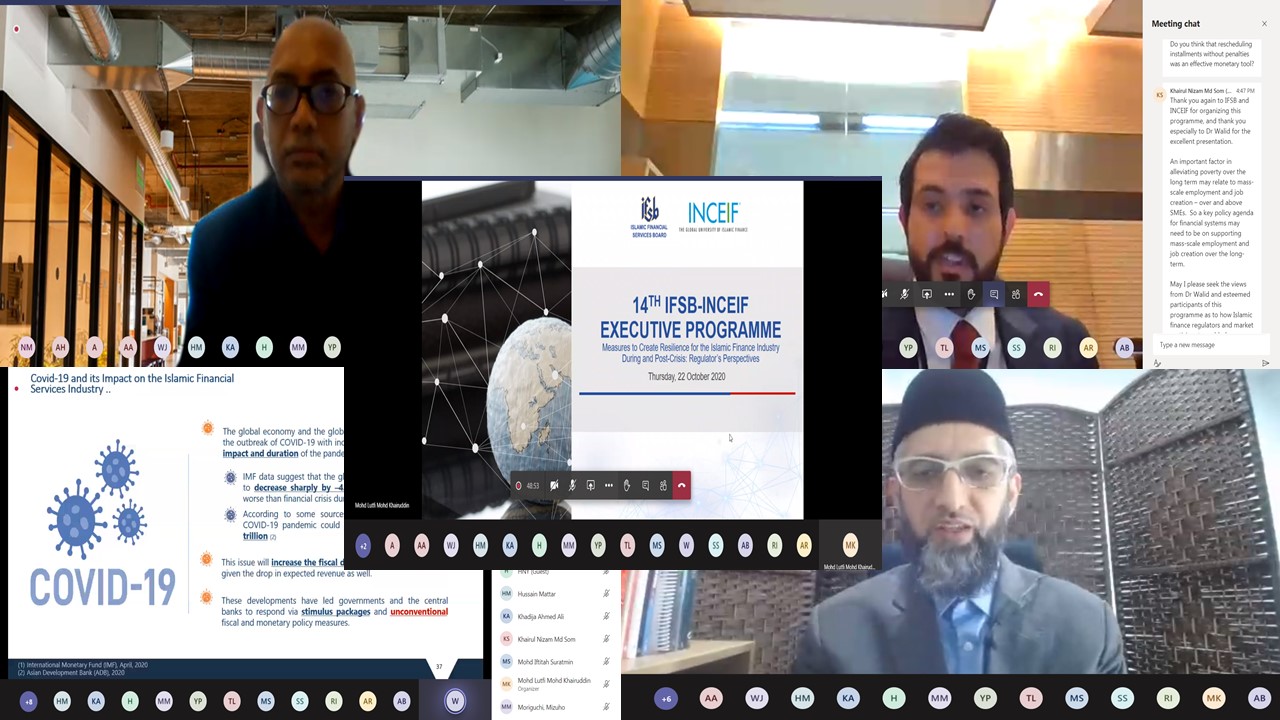
    14th IFSB-INCEIF Executive Programme – Measures to Create Resilience for the Islamic Finance Industry During and Post-Crisis: Regulator’s Perspectives

    Online

    The COVID-19-induced global recession has been an unprecedented and unique crisis for the financial system, as a completely exogenous crisis originating from outside of the financial system. The unique crisis also presented the need for unique policy responses which makes it pertinent to examine how the financial system has responded during the crisis to manage it, and how it might move forward after the crisis to ensure economic and financial system recovery, stability, resilience and growth. It is also imperative to look at the gaps in the current regulatory system that become apparent during the crisis and which requires attention by standard-setters and regulators going forward. To identify the common gaps and shortcomings of the financial regulatory frameworks and approaches in preventing the financial industry from a crisis To discuss and elaborate policy measures and actions that need to be taken by regulators in order to maintain the financial system stability and create resilience of the financial industry during a crisis. To understand steps to be taken in sustaining both financial institutions and the economic development of the country post-crisis   Event Snapshots   Programme - Event Session(s) Date Time Topics Day 1 22/10/2020 14:30 - 14:40 Opening Remarks 14:40 - 15:25 Measures to Create Resilience for the Islamic Finance Industry During and Post-Crisis: Regulator’s PerspectivesAt the end of the session, participants will be able to identify best practices and steps that need to be taken in enhancing regulatory frameworksfor crisis management in protecting the financial industry amid crisis. What enhancements in the regulatory frameworks may be considered for financial regulation to effectively address crises? Are the current regulatory regimes for crisis management adequately equipped to handle severe stress scenarios and non-economic sources of crisis? How adaptable is the regulatory framework to new or unique crises? Are there appropriate coordination and integrative mechanisms among regulators for crisis management? 15:25 - 15:30 Break 15:30 - 16:15 Session 2: Regulators’ Responses to CrisisAt the end of the session, the participants would be able to understand what policy measures and actions need to be taken by regulators in order to ensure economic and financial system stability and create resilience of the financial industry during a crisis. What are the regulatory policy measures and programs/actions adopted by the regulatory authorities to address Covid-19 impacts on the Islamic financial  sector? How have regulators dealt with crisis preparedness to ensure the safety-net of Islamic financial institutions? What are the priorities for regulatory authorities in managing the soundness of Islamic financial institutions during the crisis? Are there material differences between the Islamic banking sector and its conventional counterparts in dealing with and recovering from the crisis? 16:15 - 16:20 Break 16:20 - 17:05 Session 3: Sustainability of Financial Institutions Post Crisis At the end of the session, the participants would be able to understand steps to be taken in sustaining both financial institutions and the economic development of the country post crisis. What are the strategies for ensuring continued sustainability of Islamic financial institutions post crisis? What is the way forward for Islamic financial institutions post crisis in the midst of Banking 4.0? What are the required actions for Islamic financial institutions to channel back their liquidity to the real sector as part of the economic recovery measures of the country? What are the roles of Islamic social finance to sustain economic recovery in line with the Sustainable Development Goals (SDGs)?   Downloadable Document(s) Event Session(s) - PDF Format
  • Fri 30
    October 30, 2020 @ 2:30 PM - 6:30 PM

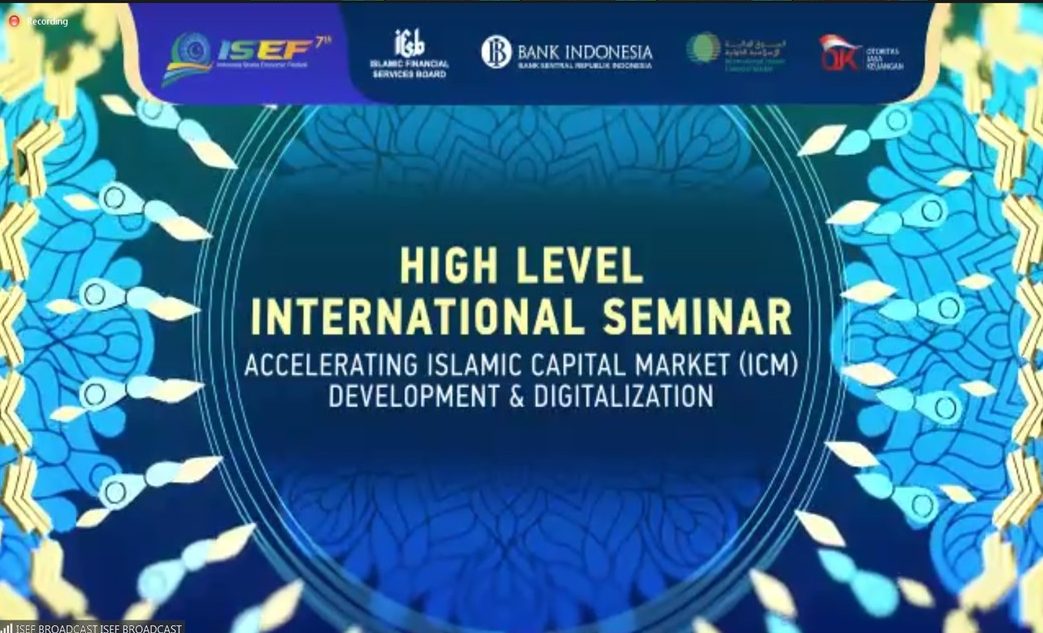
    IFSB & IIFM High-Level Seminar in conjunction with Indonesia Shariah Economic Festival 2020 – Accelerating Islamic Capital Market Development and Digitalization

    Online

    The COVID-19 pandemic and the measures taken to prevent its spread have had an increasingly significant impact on the global economy and the global financial markets. As part of policy responses to the pandemic, regulators have cut interest rates significantly that have created further incentives for investors to search for higher yield, leading to stretched valuations in some asset markets. Although accommodative conditions have helped contain near-term downside risks to the global growth, they have also fuelled a further build-up of financial vulnerabilities. Many IFSB and IIFM members have had to take a range of extraordinary regulatory and supervisory measures to alleviate the impact of COVID-19 on financial stability in their jurisdictions and preserve the orderly functioning of financial markets. Capital market development becomes important in preserving the financial markets with the robust governance. In line with that development, Islamic Capital Market (ICM) space is also considered by the regulators in the Islamic finance jurisdictions to function orderly in the financial market. Besides, ICM is ensured to function as a good intermediary for the real sector development that can help to fuel the economic growth. Against that backdrop, due to the pandemic, the rapid technological development in ICM space is taking place to develop a more inclusive, innovative and efficient capital market. Some government authorities have streamlined the ICM in their national agenda to deepen the Islamic financial market through innovative ICM product development by embracing technology particularly fintech throughdigitalization. Additionally, while governments, central banks, regulators, and international organizations have moved rapidly to address the immediate effects of COVID-19, questions remain on how policies on ICM governance and digitalisation should continue to evolve to preserve well-functioned financial market. Hence, this high level international seminar will be a timely platform for the stakeholders to discuss productively on how to address ICM development appropriately due to COVID-19 pandemic event and also rapid technological development. For registration, please click here.   Event Snapshots   Programme - Event Session(s) Date Time Topics Day 1 30/10/2020 14:30 - 15:00 Opening Remarks 15:00 - 15:30 Keynote Address 15:30 - 17:00 Session 1 – Panel Discussion: ICM Advancement as a Catalyst for Islamic Financial Market and Real Sector Development to increase the roles of ICM in the midst of pandemic Key highlights of the global macroeconomic environments and Islamic financial market current conditions as the ecosystem for ICM. Exploring the new benchmark rate for pricing the Islamic securities. Unlocking opportunities for ICM to advance with innovative products and regulations that supports Islamic financial market and real sector development with a robust governance. 17:15 - 18:30 Session 2 – Digitalisation of ICM and Market Code of Conducts Current state of the art technology of the ICM. The importance of embracing digitalization to spur the growth of ICM. Smart contract in advancing the Islamic capital market development.    Downloadable Document(s) Event Session(s) - PDF Format
  • November 2020

  • Mon 30
    November 30, 2020

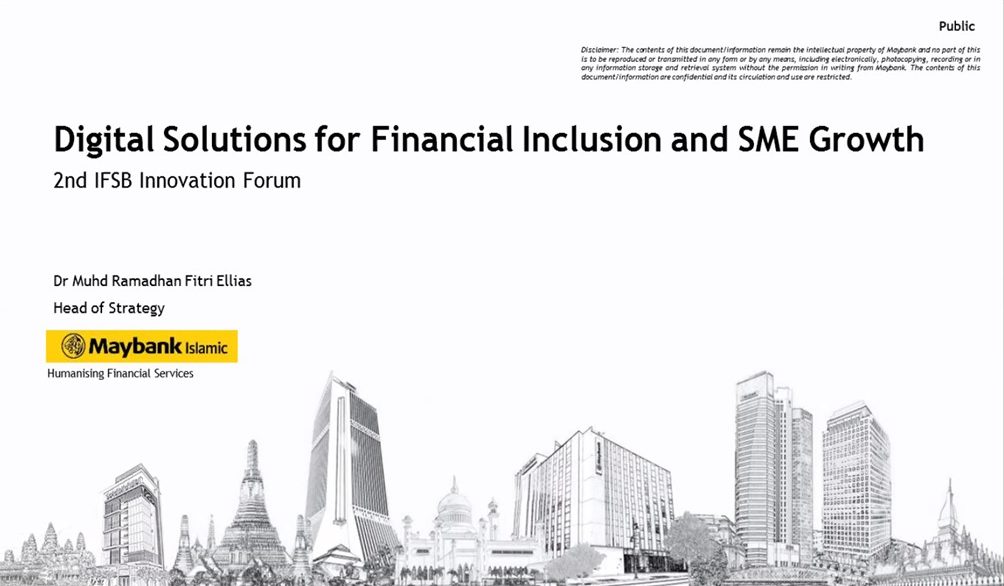
    2nd Innovation Forum – Digital Transformation of Islamic Finance and other Innovative Solutions for Post-COVID-19 Recovery

    Kuala Lumpur Kuala Lumpur, Malaysia, Malaysia

    The 2nd IFSB innovation forum sets the stage to enable the most creative minds in the Islamic financial services industry to showcase their pre-developed or conceptualised products, instruments, services, mobile applications, digital platforms and other offerings which exhibit an element of innovation and forward-looking creativity to deal with and respond to the new global reality, particularly focusing on digital and business transformation and other innovative initiatives that will improve the resilience of the Islamic finance industry and accelerate its growth during the post-COVID-19 recovery. This Forum, which is conducted as a regular biennial series, is an effort by the IFSB to bring together the Islamic finance stakeholders to focus on the promotion and development of innovative Islamic finance solutions, vital to create the competitive edge needed to sustain the Islamic financial services industry going forward. This is in-line with the IFSB's Articles of Agreement 4(d) which puts one of the objective of the IFSB as '"to enhance and coordinate initiatives to develop instruments and procedures for efficient operations and risk management". The Forum targets regulators, policy makers, Islamic financial institutions, start-ups and FinTechs, academic and research institutions, financial services providers, legal practitioners, Sharīʿah advisors and other interested stakeholders to enable an enriched discussion on enhancing the culture of innovative thinking and development in the Islamic financial services industry. The audience will be able to interact with the presenters showcasing their innovative solutions and also discuss strategies for the widespread adoption and implementation of such solutions in different jurisdictional settings for the greater benefit of the industry. The 2nd Innovation Forum will feature invited organisations to showcase their products.The presentations and product showcasing will be followed by expert discussions by selected regulators and academics on how these innovative solutions can improve efficiency and risk management in the Islamic financial services industry. This Forum is open for All. For registration and enquiries, please email Ms. Noor Azmah Mohd Yusof at [email protected] Event Snapshots Programme - Event Session(s) Date Time Topics Day 1 30/11/2020 15:30 - 15:45 Opening Remarks 15:45 - 18:30 Digital Transformation of Islamic Finance and other Innovative Solutions for Post-Covid-19 Recovery   Downloadable Documents Event Session(s) - PDF Format

  • December 2020

  • Mon 14
    December 14, 2020

    Roundtable on Takaful

    Online

    Event Snapshots

  • Wed 16
    December 16, 2020

    21st Islamic Financial Stability Forum – The Implications of COVID-19 on the Stability of Islamic Financial Services Industry

    Kuala Lumpur Kuala Lumpur, Malaysia, Malaysia

    The IFSF provides opportunity to renowned IFSI leaders, decision markers and regulators to offer diverse perspectives as well as exchange ideas with industry stakeholders across different segments of the IFSI on related regulatory and policy initiatives and issues. This 21st IFSF involves a session of panel discussion that focuses on the COVID-19 related issues and their implication for the stability and resilience of the IFSI. Further, it also attempts to have forward looking policy to prevent the potential and unprecedented crisis and industry responses facing the current and future crisis. The COVID-19 pandemic no doubt exerts significant pressures on both the regulatory and supervisory authorities (RSAs) as well as supervised firms including the institutions offering Islamic financial services (IIFS). This is especially in terms of coping with the dynamics of the consequences of the pandemic depending on its effects and duration, as well as adapting supervisory approaches and working practice respectively toward the apparent, anticipated, and obscure risks that may result due to contraction in the real economy to which the IFSI is highly exposed. In addition, it is likely that the need to urgently address the matters arising from the outbreak of COVID-19 may have subsumed attention to other wider issues relating to how the IFSI complements the achievement of the sustainable development goals including the social development. These developments will obviously put both the stability and resilience of the IFSI to test in the later part of 2020 and perhaps beyond. The specific issues relating to these broad concerns are amongst the focus of the panel discussion session of this 21st IFSF besides the prospect of Islamic finance taken into account the lesson learnt from the pandemic.   Event Snapshots   Programme - Event Session(s) Date Time Topics Day 1 16/12/2020 14:30 - 14:40 Opening Remarks 14:40 - 16:00 Panel Discussion on Assessing the effectiveness of regulatory and supervisory response to maintain financial stability upon the impact of COVID-19 and way ahead In many jurisdictions, recommendations have been offered on the use of regulatory buffers, the need to preserve compliance with international standards, and promote international and inter-organisational coordination. A few have also looked at these issues with focus on the specificities of Islamic financial services such as balance sheet components, relatively smaller size of the IFSI in many jurisdictions, and the state of the economy of countries where Islamic finance is practiced. While the effect of the first wave of the pandemic is starting to manifest, especially as various fiscal, monetary and other stimulus introduced by the various governments are being relaxed, the impact of the second wave of COVID-19 is also likely to take effect in the coming months. Not only might there be a significant increase in credit risk due to financing delinquencies, market liquidity might also be strained, and asset markets might be disrupted. Moreover, the indispensability of digitalising financial services due to social distancing as a new normal to flatten the curve of the pandemic also presents technology-related risks that might result from staff remote access to financial network as well as outsourcing of cloud services for instance to third-parties. Also, the abruptness and pervasiveness of the COVID-19 pandemic and the responses it elicited might also have impacted on the requisite attention needed on other wider issues including for instance, climate change and financial inclusion which are also considered important to the IFSI. While these challenges affect the entire financial system in a jurisdiction, their implications for the IFSI might also present peculiar effects given the specificities of Islamic finance.   Discussion Points: What is the effect of the prudential regulatory and supervisory policy response to COVID-19to maintain financial stability of IFSI in general? Are various stimulus packages introduced stimulating new spending and preventing job losses quickly enough as desired especially to the households and SMEs to which the Islamic banks are highly exposed? Are there any unexpected prudential consequences peculiar to the specificities of the IFSI that have emerged from the crisis and what are their implications? How can the Islamic banks deal with regulatory capital treatment of ECLs given that IFRS-9 did not specify such treatment for profit and loss sharing contract, for instance? What are the peculiar impediments and risks to the digital transformation of the IFSI as necessitated by COVID-19? Are there legacy infrastructure, human capital or capital budgeting constraints, for instance? How effective is the coordination and communication among various regulators and supervisors of Islamic finance segments in response to COVID-19? What factors should the regulatory and supervisory authorities consider to be of utmost importance, as countries where Islamic finance is practiced gradually ease the lockdown? What are the forward looking policy to be pursued taken into account the lesson learnt from pandemic? To what extent has the focus on the effect of the pandemic subsumed attention on other wider issues and initiatives that are pertinent to Islamic finance such as financial inclusion, climate change, etc? · 16:00 - 16:15 Q&A Session

  • May 2021

  • Tue 25
    May 25, 2021 @ 9:30 AM - 11:45 PM

    12th IFSB Public Lecture on Financial Policy and Stability

    Virtual

    Programme - Event Session(s) Date Time Topics Day 1 25/05/2021 09:30 - 09:45 Welcoming and Opening Remarks  Dr. Bello Lawal Danbatta, Secretary-General, IFSB 09:45 - 10:30 Public Lecture 1: Current and Post-Pandemic Financial System Stability Challenges: The Way Ahead Speaker: Dr. Tobias Adrian, Financial Counsellor and Director of the Monetary and Capital Markets Department – International Monetary Fund The COVID-19 pandemic has resulted in economic and financial downturns and market turmoil affecting almost every country around the globe in 2020. To alleviate economic pressures, governments adopted various economic and financial policy measures such as tax relief, postponing loan/financing interest/profit payments, special liquidity to labour-intensive sectors (SMEs, etc) and easing macroprudential and microprudential indicators to maintain financial system stability. The effects of the pandemic seem to continue into 2021, as some countries struggle while others show slight indications of economic recovery. Overall, the majority of countries are continuing their efforts to stimulate the economy and contain the pandemic, through the rollout of vaccination programmes, strict health protocols and increasing health facilities. Fortunately, financial system stability as shown by the improved financial market activities, banking and nonbank performance and investors’ investment activities indicates positive recovery. Amongst the lessons learnt from the pandemic are integrated and coordinated economic and financial policies among authorities; digital transformation and financial technology; more social, health and welfare-oriented economic and financial activities. Banks and financial systems as a whole are witnessing transformation to become more agile and adaptive towards sustainable practices. Some issues to be stressed and elaborated on are: (1) How much has the pandemic transformed the current economic and financial system? (2) How to maintain economic and financial system stability and what policies are more likely to remain in the post-pandemic era and beyond? (3) What are shifting paradigms occurred or need to occur to maintain economic and financial stability? (4) What will be the roles of authorities in post-pandemic era and beyond? 10:30 - 11:00 Break 11:00 - 11:45 Public Lecture 2: Islamic Financial System Stability: Post Pandemic Impacts and Way Ahead Speakers: Dr. Zamir Iqbal, Vice President, Finance, Islamic Development Bank Professor Dr. Asad Zaman, Director General International, Institute of Islamic Economics. International Islamic University Islamabad Economic and financial pressures and instability resulting from the pandemic have transformed economic and financial transactions. Electronic contracts and financial agreements, electronic transactions (e-banking, e-sukuk, e-money, etc), financial technology (less physical interactions) and digital currencies have seen wider use in the business and financial markets.       Due to massive development of start-up companies, various social media and digital-based transactions have created new ways of collecting, investing and managing both commercial and social funds. Securities crowdfunding, e-payment of zakah, waqf, including their distribution via virtual platforms, may lead to potential Sharīʻah risks. These phenomena vividly impact the global Islamic financial system stability and can lead to the transformation of Islamic finance system to face post pandemic challenges and be more agile, adaptive and innovative.   Lately, Islamic finance industry (banks, capital market, takaful) has changed its business model as well as technological adoption in which there are techno-based Islamic finance applications, more social responsive Islamic finance transactions and including eco-friendly Islamic investment applied during and possibly post pandemic condition.     Some areas to be discussed: (1) How is the global Islamic financial (IF) system stability during and post pandemic? Is the policy flexibility in the pandemic caused the resilience of IF or  (2) What are exit policies currently applied in most of jurisdictions to sustain the IF stability?   (3) What are lessons learnt from the pandemic to be responded and incorporated in the current IF practices? (4) What kinds of transformation required by IF to cope with the future economic and finance challenges?     11:45 - 11:45 End of the Public Lecture

  • June 2021

  • Thu 24
    June 24, 2021 @ 4:30 PM - 10:00 PM

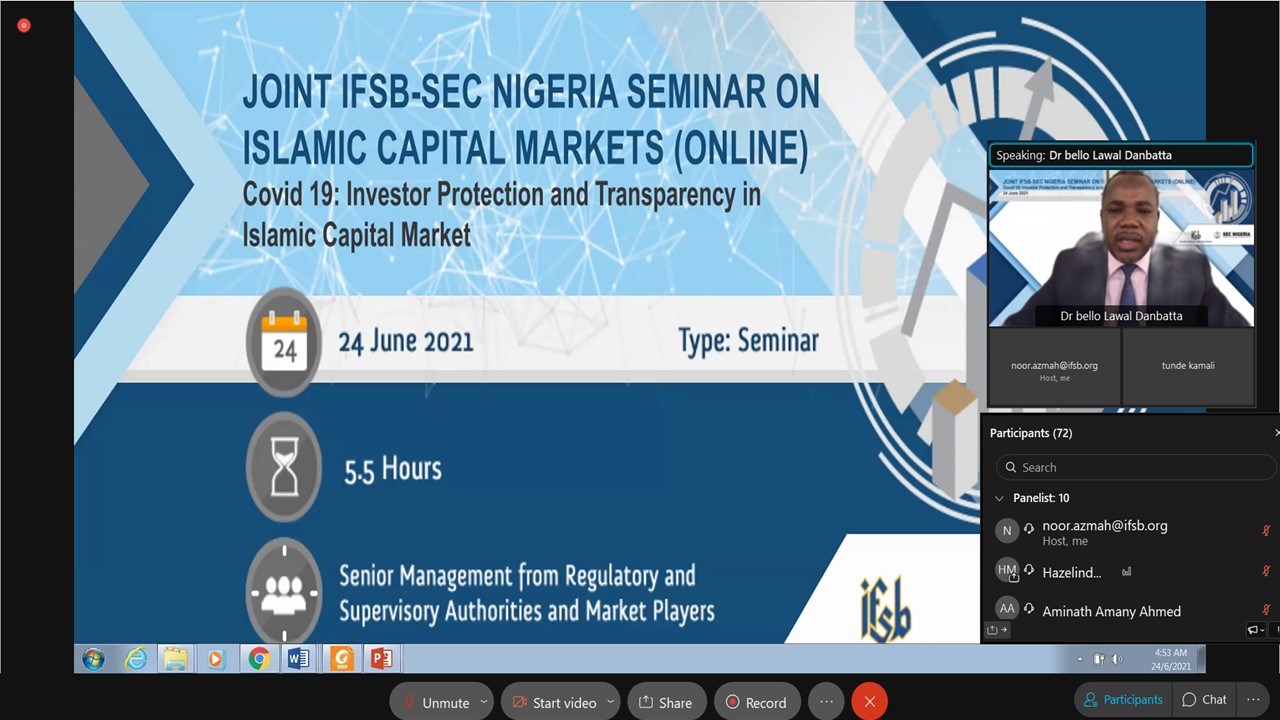
    Joint IFSB-SEC Nigeria Seminar on Islamic Capital Market

    Online

    COVID 19: INVESTOR PROTECTION AND TRANSPARENCY IN ISLAMIC CAPITAL MARKET The pandemic has unexceptionally affected all economic and financial sectors globally, including the Islamic financial services sector.  Given the ongoing uncertainty created by the pandemic and the potential risks it poses for economic growth and financial stability, protecting investors against possible market failures, as well as enhancing transparency and information available to investors are essential in regaining investor trust and confidence in the Islamic capital markets, which is in turn, crucial to prevent any deterioration of market conditions. Many market failures directly impact investors, including asymmetry of information, agency problems or detrimental conflicts of interest. They may affect the functioning of the market and contribute to the perception that capital markets are an unsafe environment. Thus, it is imperative for policy makers and regulators to address these issues through regulatory intervention, in order to rebuild investor confidence during volatile market conditions and to effectively address possible market failures that could impact the level of protection of investors. Better protected investors are also likely to make more informed investment decisions and be less prone to react irrationally to market events or follow “herd behavior” which are disruptive for financial markets and the economy as a whole. Thus, transparency and investor protection can be seen as factors that ultimately contribute to the stability of financial markets. The seminar therefore aims to increase awareness of the importance of investor protection and transparency in fostering investor confidence and ultimately the sustainability and stability of the Islamic capital markets and to provide a platform to discuss critical policy issues arising in the context of the current global financial environment. Objectives The seminars’ main objectives are to: Address Islamic finance-specific issues in relation to investor protection. Discuss best practices for investor protection in the ICM and the elements of a robust investor protection framework. Highlight best practices and guidelines on disclosure requirements for ICM products, specifically for ṣukūk and Islamic collective investment schemes (ICIS). Identify issues arising from the current global environment, and share policy actions taken by various regulators and policy makers to address emerging challenges and issues. Programme Outcome At the end of the seminar, participants will have a comprehensive understanding on investor protection and disclosure requirements to strengthen investor confidence and improve financial market performance. The seminar will be structured around guidance from IFSB standards, as well as experiences from the industry.  Participants will be able to takeaway insights on the various policy approaches and best practices in different jurisdictions to address new and emerging issues related to investor protection and transparency in light of the new global realities. Programme Approach Interactive discussions on a wide array of issues on investor protection and transparency in the ICM Discussion on the best market practices and regulatory challenges Event Snapshots   Programme - Event Session(s) Date Time Topics Day 1 24/06/2021 16:30 - 16:45 Welcoming Remarks (IFSB) Dr. Bello Lawal Danbatta, Secretary-General, Islamic Financial Services Board 16:45 - 17:00 Opening Remarks (SEC Nigeria) Mr. Lamido Yugaga, Director General, SEC Nigeria 17:00 - 17:45 Session 1: Overview of the Islamic Capital Markets in Nigeria Development and growth of the Islamic capital markets in Nigeria Islamic finance development, products and issuances in Nigeria Regulatory developments and challenges COVID-19 and impact on the market Presenter: Mr. Abdulkadir Abbas, Head of Department – Securities and Investment Services, SEC Nigeria 17:45 - 17:50 Short Break 17:50 - 18:30 Session 2: Strengthening Investor Protection in the Islamic Capital Markets Overview of regulatory issues and the key principles of investor protection; Overview of the global Islamic capital markets and trends The role of product governance, conduct of business requirements (including client assets, best execution, and conflicts of interest etc.), and good practices in relation to investor redress and investor education, and; Emerging investor protection issues in the Islamic capital markets in the context of the current global environment Presenter: Ms. Aminath Amany Ahmed, Member of the Secretariat, Islamic Financial Services Board   18:30 - 19:30 Afternoon Break 19:30 - 20:15 Session 3: Enhancing Transparency in the Islamic Capital Market (Sukuk) Principles of transparency and disclosure for Sukuk and regulatory best practices Overview of key regulatory considerations and specificities of Sukuk Role of transparency and disclosure in protecting Sukuk investors Addressing emerging issues and challenges for Sukuk through better informed investors Presenter: Peter Casey, Consultant, Islamic Financial Services Board 20:15 - 20:20 Short Break 20:20 - 21:05 Session 4: Enhancing Transparency in the Islamic Capital Market (ICIS) Overview of key regulatory considerations and specificities of ICIS Principles of transparency and disclosure for ICIS and regulatory best practices Role of transparency and disclosure in protecting ICIS investors Addressing emerging issues and challenges for ICIS through better informed investors Presenter: Peter Casey, Consultant, Islamic Financial Services Board   21:05 - 21:15 Short Break 21:15 - 22:00 Session 5: Panel: Safeguarding investors in a challenging global environment Implications of the COVID-19 pandemic for the Islamic capital markets Policy actions taken by regulators to mitigate the impact of the pandemic Key investor protection issues arising from the unprecedented economic and financial market conditions and addressing these issues; Promoting investors’ confidence in an uncertain environment through greater market transparency, assessment and information. Q&A on specific considerations and policy issues unique to the Islamic capital market and the way forward. Panelists: Peter Casey, IFSB Consultant (Lead Panelist) Mr. Abdulkadir Abbas, Head of Department – Securities and Investment Services, SEC Nigeria Mrs. Hajara Adeola, Managing Director, Lotus Capital Limited Mr. Hichem Bouqniss, Execuitve Director, International Islamic Liquidity Management Corporation

  • Wed 30
    June 30, 2021 @ 1:30 PM - 6:00 PM

    Joint IFSB-CMA Kenya Seminar on Islamic Capital Market

    COVID 19: INVESTOR PROTECTION AND TRANSPARENCY IN ISLAMIC CAPITAL MARKET The pandemic has unexceptionally affected all economic and financial sectors globally, including the Islamic financial services sector.  Given the ongoing uncertainty created by the pandemic and the potential risks it poses for economic growth and financial stability, protecting investors against possible market failures, as well as enhancing transparency and information available to investors are essential in regaining investor trust and confidence in the Islamic capital markets, which is in turn, crucial to prevent any deterioration of market conditions. Many market failures directly impact investors, including asymmetry of information, agency problems or detrimental conflicts of interest. They may affect the functioning of the market and contribute to the perception that capital markets are an unsafe environment. Thus, it is imperative for policy makers and regulators to address these issues through regulatory intervention, in order to rebuild investor confidence during volatile market conditions and to effectively address possible market failures that could impact the level of protection of investors. Better protected investors are also likely to make more informed investment decisions and be less prone to react irrationally to market events or follow “herd behavior” which are disruptive for financial markets and the economy as a whole. Thus, transparency and investor protection can be seen as factors that ultimately contribute to the stability of financial markets. The seminar therefore aims to increase awareness of the importance of investor protection and transparency in fostering investor confidence and ultimately the sustainability and stability of the Islamic capital markets and to provide a platform to discuss critical policy issues arising in the context of the current global financial environment. Objectives The seminars’ main objectives are to: Address Islamic finance-specific issues in relation to investor protection. Discuss best practices for investor protection in the ICM and the elements of a robust investor protection framework. Highlight best practices and guidelines on disclosure requirements for ICM products, specifically for ṣukūk and Islamic collective investment schemes (ICIS). Identify issues arising from the current global environment, and share policy actions taken by various regulators and policy makers to address emerging challenges and issues. Programme Outcome At the end of the seminar, participants will have a comprehensive understanding on investor protection and disclosure requirements to strengthen investor confidence and improve financial market performance. The seminar will be structured around guidance from IFSB standards, as well as experiences from the industry.  Participants will be able to takeaway insights on the various policy approaches and best practices in different jurisdictions to address new and emerging issues related to investor protection and transparency in light of the new global realities. Programme Approach Interactive discussions on a wide array of issues on investor protection and transparency in the ICM Discussion on the best market practices and regulatory challenges Programme - Event Session(s) Date Time Topics Day 1 30/06/2021 13:30 - 13:45 Welcoming Remarks (IFSB) Dr. Bello Lawal Danbatta, Secretary-General, Islamic Financial Services Board 13:45 - 14:00 Opening Remarks (CMA Kenya) Mr. Wycliffe Shamiah, Chief Executive Officer, Capital Market Authority 14:00 - 15:00 Session 1: Introduction to the Islamic Capital Markets Development and growth of the Islamic capital markets in Nigeria Islamic finance development, products and issuances in Nigeria Regulatory developments and challenges COVID-19 and impact on the market Presenter: Mr. Saad Rahman, Deputy Chief Executive Officer, Salaam Investment Bank Kenya (SIBK) 15:00 - 15:15 Short Break 15:15 - 16:15 Session 2: Strengthening Investor Protection in the Islamic Capital Markets Overview of the global Islamic capital markets and trends Overview of regulatory issues and the key principles of investor protection; The role of product governance, conduct of business requirements (including client assets, best execution, and conflicts of interest etc.), and good practices in relation to investor redress and investor education, and; Emerging investor protection issues in the Islamic capital markets in the context of the current global environment  Presenter: Ms. Aminath Amany Ahmed, Member of the Secretariat, Islamic Financial Services Board 16:15 - 16:30 Short Break 16:30 - 17:00 Session 3: Enhancing Transparency in the Islamic Capital Market (Sukuk) Overview of key regulatory considerations and specificities of Sukuk Principles of transparency and disclosure for Sukuk and regulatory best practices Role of transparency and disclosure in protecting Sukuk investors Addressing emerging issues and challenges for Sukuk through better informed investors Presenter:  Peter Casey, Consultant, Islamic Financial Services Board   17:00 - 17:15 Short Break 17:15 - 18:00 Session 4: Panel: Safeguarding investors in a challenging global environment Implications of the COVID-19 pandemic for the Islamic capital markets Policy actions taken by regulators to mitigate the impact of the pandemic Key investor protection issues arising from the unprecedented economic and financial market conditions and addressing these issues; Promoting investors’ confidence in an uncertain environment through greater market transparency, assessment and information. Q&A on specific considerations and policy issues unique to the Islamic capital market and the way forward. Panelists: Peter Casey, IFSB Consultant (Lead Panelist) Mr. Luke Ombara, Policy and Market Development, CMA Kenya Mr. Saad Rahman, Deputy Chief Executive Officer, Salaam Investment Bank Kenya (SIBK)

  • July 2021

  • Thu 1
    July 1, 2021

    Joint IFSB-AIFC Seminar on Islamic Capital Market

    Online

    Programme Overview The pandemic has unexceptionally affected all economic and financial sectors globally, including the Islamic financial services sector.  Given the ongoing uncertainty created by the pandemic and the potential risks it poses for economic growth and financial stability, protecting investors against possible market failures, as well as enhancing transparency and information available to investors are essential in regaining investor trust and confidence in the Islamic capital markets, which is in turn, crucial to prevent any deterioration of market conditions. Many market failures directly impact investors, including asymmetry of information, agency problems or detrimental conflicts of interest. They may affect the functioning of the market and contribute to the perception that capital markets are an unsafe environment. Thus, it is imperative for policy makers and regulators to address these issues through regulatory intervention, in order to rebuild investor confidence during volatile market conditions and to effectively address possible market failures that could impact the level of protection of investors. Better protected investors are also likely to make more informed investment decisions and be less prone to react irrationally to market events or follow “herd behavior” which are disruptive for financial markets and the economy as a whole. Thus, transparency and investor protection can be seen as factors that ultimately contribute to the stability of financial markets. The seminars’ main objectives are to:  Address Islamic finance-specific issues in relation to investor protection. Discuss best practices for investor protection in the ICM and the elements of a robust investor protection framework. Highlight best practices and guidelines on disclosure requirements for ICM products, specifically for ṣukūk and Islamic collective investment schemes (ICIS). Identify issues arising from the current global environment, and share policy actions taken by various regulators and policy makers to address emerging challenges and issues.The seminar therefore aims to increase awareness of the importance of investor protection and transparency in fostering investor confidence and ultimately the sustainability and stability of the Islamic capital markets and to provide a platform to discuss critical policy issues arising in the context of the current global financial environment Programme Outcome At the end of the seminar, participants will have a comprehensive understanding on investor protection and disclosure requirements to strengthen investor confidence and improve financial market performance. The seminar will be structured around guidance from IFSB standards, as well as experiences from the industry.  Participants will be able to takeaway insights on the various policy approaches and best practices in different jurisdictions to address new and emerging issues related to investor protection and transparency in light of the new global realities. Programme Approach Interactive discussions on a wide array of issues on investor protection and transparency in the ICM. Discussion on the best market practices and regulatory challenges. Programme - Event Session(s) Date Time Topics Day 1 01/07/2021 12:00 - 12:50 Session 1: Strengthening Investor Protection in the Islamic Capital Markets Overview of the global Islamic capital markets and trends Overview of regulatory issues and the key principles of investor protection; The role of product governance, conduct of business requirements (including client assets, best execution, and conflicts of interest etc.), and good practices in relation to investor redress and investor education, and; Emerging investor protection issues in the Islamic capital markets in the context of the current global environment Presenter:  Aminath Amany Ahmed, Member of the Secretariat, Islamic Financial Services Board (IFSB) 13:00 - 13:50 Session 2: Enhancing Transparency in the Sukuk Market Overview of key regulatory considerations and specificities of Sukuk Principles of transparency and disclosure for Sukuk practices Role of transparency and disclosure in protecting Sukuk Addressing emerging issues and challenges for Sukuk through better informed investors  Presenter:  Peter Casey, IFSB Consultant  14:00 - 14:50 Session 3: Enhancing Transparency in the Islamic Capital Market (ICIS) Overview of key regulatory considerations and specificities of ICIS Principles of transparency and disclosure for ICIS and regulatory best practices Role of transparency and disclosure in protecting ICIS investors Addressing emerging issues and challenges for ICIS through better informed investors Presenter: Peter Casey, IFSB Consultant 15:00 - 15:50 Q&A - Safeguarding investors in a challenging global environment Implications of the COVID-19 pandemic for the Islamic capital markets Policy actions taken by regulators to mitigate the impact of the pandemic Key investor protection issues arising from the unprecedented economic and financial market conditions and addressing these issues; Promoting investors’ confidence in an uncertain environment through greater market transparency, assessment and information. Q&A on specific considerations and policy issues unique to the Islamic capital market and the way forward. Panelists: Dr. Rifki Ismal, Assistant Secretary-General of the IFSB Peter Casey, IFSB Consultant Mr. Noraizat Shik Ahmad, General Manager, ICM Product Development, Securities Commission Malaysia Mr. Akber Khan Senior Director, Asset Management Group, Al Rayan Investment  

  • Previous Events
  • Today
  • Next Events
  • Google Calendar
  • iCalendar
  • Outlook 365
  • Outlook Live
  • Export .ics file
  • Export Outlook .ics file

Level 5, Sasana Kijang, Bank Negara Malaysia, 2, Jalan Dato’ Onn, 50480 Kuala Lumpur, Malaysia.

About IFSB

  • Establishment
  • Organisational Structure
  • IFSB Membership
  • Council
  • Commitee
  • Working Groups
  • Task Forces
  • Secretariat

Standard Development

  • Due Process
  • Work Programme
  • Core Principles
  • Standards
  • Technical Notes
  • Guidance Notes

Publications

  • Research
  • Islamic Financial Stability Forum
  • Islamic Financial Stability Report
  • Public Lecture Series
  • Other Reports
  • Other Proceedings
  • The IFSB Bulletin
  • Digitalisation Platform

Data

Implementations

  • Workshops
  • Technical Assistance / Policy Advice
  • e-Learning
  • Impact and Consistency Assessment Programme (ICAP)
  • Implementation Guidelines
  • Implementation Survey
  • Sharing of Experience
  • Training of Trainers Program

Events & Media

  • Press Release
  • IFSB Annual Events
  • Awareness Programme
  • Meetings
  • Video Gallery
  • Speeches
  • Photo Gallery

Consultations

MEMA

Policies

Level 5, Sasana Kijang, Bank Negara Malaysia, 2, Jalan Dato’ Onn, 50480 Kuala Lumpur, Malaysia.

About IFSB

  • Establishment
  • Organisational Structure
  • IFSB Membership
  • Council
  • Commitee
  • Working Groups
  • Task Forces
  • Secretariat

Standard Development

  • Due Process
  • Work Programme
  • Core Principles
  • Standards
  • Technical Notes
  • Guidance Notes

Publications

  • Research
  • Islamic Financial Stability Forum
  • Islamic Financial Stability Report
  • Public Lecture Series
  • Proceeding
  • Other Proceedings
  • IFSB Bulletin
  • Digitalisation Platform

Data

Events & Media

  • Press Release
  • Awareness Programme
  • IFSB Annual Events
  • Meetings
  • Video Gallery
  • Speeches
  • Photo Gallery

Implementations

  • Workshop
  • Technical Assistance / Policy Advice
  • e-Learning
  • Impact and Consistency Assessment Programme (ICAP)
  • Implementation Guidelines
  • Implementation Survey
  • Sharing of Experience
  • Training of Trainers Program

Consultations

MEMA

Policies

© 2025 ISLAMIC FINANCIAL SERVICES BOARD . All Rights Reserved.