Roundtable on Takaful
Event Snapshots
Event Snapshots
The IFSF provides opportunity to renowned IFSI leaders, decision markers and regulators to offer diverse perspectives as well as exchange ideas with industry stakeholders across different segments of the IFSI on related regulatory and policy initiatives and issues. This 21st IFSF involves a session of panel discussion that focuses on the COVID-19 related issues and their implication for the stability and resilience of the IFSI. Further, it also attempts to have forward looking policy to prevent the potential and unprecedented crisis and industry responses facing the current and future crisis. The COVID-19 pandemic no doubt exerts significant pressures on both the regulatory and supervisory authorities (RSAs) as well as supervised firms including the institutions offering Islamic financial services (IIFS). This is especially in terms of coping with the dynamics of the consequences of the pandemic depending on its effects and duration, as well as adapting supervisory approaches and working practice respectively toward the apparent, anticipated, and obscure risks that may result due to contraction in the real economy to which the IFSI is highly exposed. In addition, it is likely that the need to urgently address the matters arising from the outbreak of COVID-19 may have subsumed attention to other wider issues relating to how the IFSI complements the achievement of the sustainable development goals including the social development. These developments will obviously put both the stability and resilience of the IFSI to test in the later part of 2020 and perhaps beyond. The specific issues relating to these broad concerns are amongst the focus of the panel discussion session of this 21st IFSF besides the prospect of Islamic finance taken into account the lesson learnt from the pandemic. Event Snapshots Programme - Event Session(s) Date Time Topics Day 1 16/12/2020 14:30 - 14:40 Opening Remarks 14:40 - 16:00 Panel Discussion on Assessing the effectiveness of regulatory and supervisory response to maintain financial stability upon the impact of COVID-19 and way ahead In many jurisdictions, recommendations have been offered on the use of regulatory buffers, the need to preserve compliance with international standards, and promote international and inter-organisational coordination. A few have also looked at these issues with focus on the specificities of Islamic financial services such as balance sheet components, relatively smaller size of the IFSI in many jurisdictions, and the state of the economy of countries where Islamic finance is practiced. While the effect of the first wave of the pandemic is starting to manifest, especially as various fiscal, monetary and other stimulus introduced by the various governments are being relaxed, the impact of the second wave of COVID-19 is also likely to take effect in the coming months. Not only might there be a significant increase in credit risk due to financing delinquencies, market liquidity might also be strained, and asset markets might be disrupted. Moreover, the indispensability of digitalising financial services due to social distancing as a new normal to flatten the curve of the pandemic also presents technology-related risks that might result from staff remote access to financial network as well as outsourcing of cloud services for instance to third-parties. Also, the abruptness and pervasiveness of the COVID-19 pandemic and the responses it elicited might also have impacted on the requisite attention needed on other wider issues including for instance, climate change and financial inclusion which are also considered important to the IFSI. While these challenges affect the entire financial system in a jurisdiction, their implications for the IFSI might also present peculiar effects given the specificities of Islamic finance. Discussion Points: What is the effect of the prudential regulatory and supervisory policy response to COVID-19to maintain financial stability of IFSI in general? Are various stimulus packages introduced stimulating new spending and preventing job losses quickly enough as desired especially to the households and SMEs to which the Islamic banks are highly exposed? Are there any unexpected prudential consequences peculiar to the specificities of the IFSI that have emerged from the crisis and what are their implications? How can the Islamic banks deal with regulatory capital treatment of ECLs given that IFRS-9 did not specify such treatment for profit and loss sharing contract, for instance? What are the peculiar impediments and risks to the digital transformation of the IFSI as necessitated by COVID-19? Are there legacy infrastructure, human capital or capital budgeting constraints, for instance? How effective is the coordination and communication among various regulators and supervisors of Islamic finance segments in response to COVID-19? What factors should the regulatory and supervisory authorities consider to be of utmost importance, as countries where Islamic finance is practiced gradually ease the lockdown? What are the forward looking policy to be pursued taken into account the lesson learnt from pandemic? To what extent has the focus on the effect of the pandemic subsumed attention on other wider issues and initiatives that are pertinent to Islamic finance such as financial inclusion, climate change, etc? · 16:00 - 16:15 Q&A Session
Programme - Event Session(s) Date Time Topics Day 1 25/05/2021 09:30 - 09:45 Welcoming and Opening Remarks Dr. Bello Lawal Danbatta, Secretary-General, IFSB 09:45 - 10:30 Public Lecture 1: Current and Post-Pandemic Financial System Stability Challenges: The Way Ahead Speaker: Dr. Tobias Adrian, Financial Counsellor and Director of the Monetary and Capital Markets Department – International Monetary Fund The COVID-19 pandemic has resulted in economic and financial downturns and market turmoil affecting almost every country around the globe in 2020. To alleviate economic pressures, governments adopted various economic and financial policy measures such as tax relief, postponing loan/financing interest/profit payments, special liquidity to labour-intensive sectors (SMEs, etc) and easing macroprudential and microprudential indicators to maintain financial system stability. The effects of the pandemic seem to continue into 2021, as some countries struggle while others show slight indications of economic recovery. Overall, the majority of countries are continuing their efforts to stimulate the economy and contain the pandemic, through the rollout of vaccination programmes, strict health protocols and increasing health facilities. Fortunately, financial system stability as shown by the improved financial market activities, banking and nonbank performance and investors’ investment activities indicates positive recovery. Amongst the lessons learnt from the pandemic are integrated and coordinated economic and financial policies among authorities; digital transformation and financial technology; more social, health and welfare-oriented economic and financial activities. Banks and financial systems as a whole are witnessing transformation to become more agile and adaptive towards sustainable practices. Some issues to be stressed and elaborated on are: (1) How much has the pandemic transformed the current economic and financial system? (2) How to maintain economic and financial system stability and what policies are more likely to remain in the post-pandemic era and beyond? (3) What are shifting paradigms occurred or need to occur to maintain economic and financial stability? (4) What will be the roles of authorities in post-pandemic era and beyond? 10:30 - 11:00 Break 11:00 - 11:45 Public Lecture 2: Islamic Financial System Stability: Post Pandemic Impacts and Way Ahead Speakers: Dr. Zamir Iqbal, Vice President, Finance, Islamic Development Bank Professor Dr. Asad Zaman, Director General International, Institute of Islamic Economics. International Islamic University Islamabad Economic and financial pressures and instability resulting from the pandemic have transformed economic and financial transactions. Electronic contracts and financial agreements, electronic transactions (e-banking, e-sukuk, e-money, etc), financial technology (less physical interactions) and digital currencies have seen wider use in the business and financial markets. Due to massive development of start-up companies, various social media and digital-based transactions have created new ways of collecting, investing and managing both commercial and social funds. Securities crowdfunding, e-payment of zakah, waqf, including their distribution via virtual platforms, may lead to potential Sharīʻah risks. These phenomena vividly impact the global Islamic financial system stability and can lead to the transformation of Islamic finance system to face post pandemic challenges and be more agile, adaptive and innovative. Lately, Islamic finance industry (banks, capital market, takaful) has changed its business model as well as technological adoption in which there are techno-based Islamic finance applications, more social responsive Islamic finance transactions and including eco-friendly Islamic investment applied during and possibly post pandemic condition. Some areas to be discussed: (1) How is the global Islamic financial (IF) system stability during and post pandemic? Is the policy flexibility in the pandemic caused the resilience of IF or (2) What are exit policies currently applied in most of jurisdictions to sustain the IF stability? (3) What are lessons learnt from the pandemic to be responded and incorporated in the current IF practices? (4) What kinds of transformation required by IF to cope with the future economic and finance challenges? 11:45 - 11:45 End of the Public Lecture
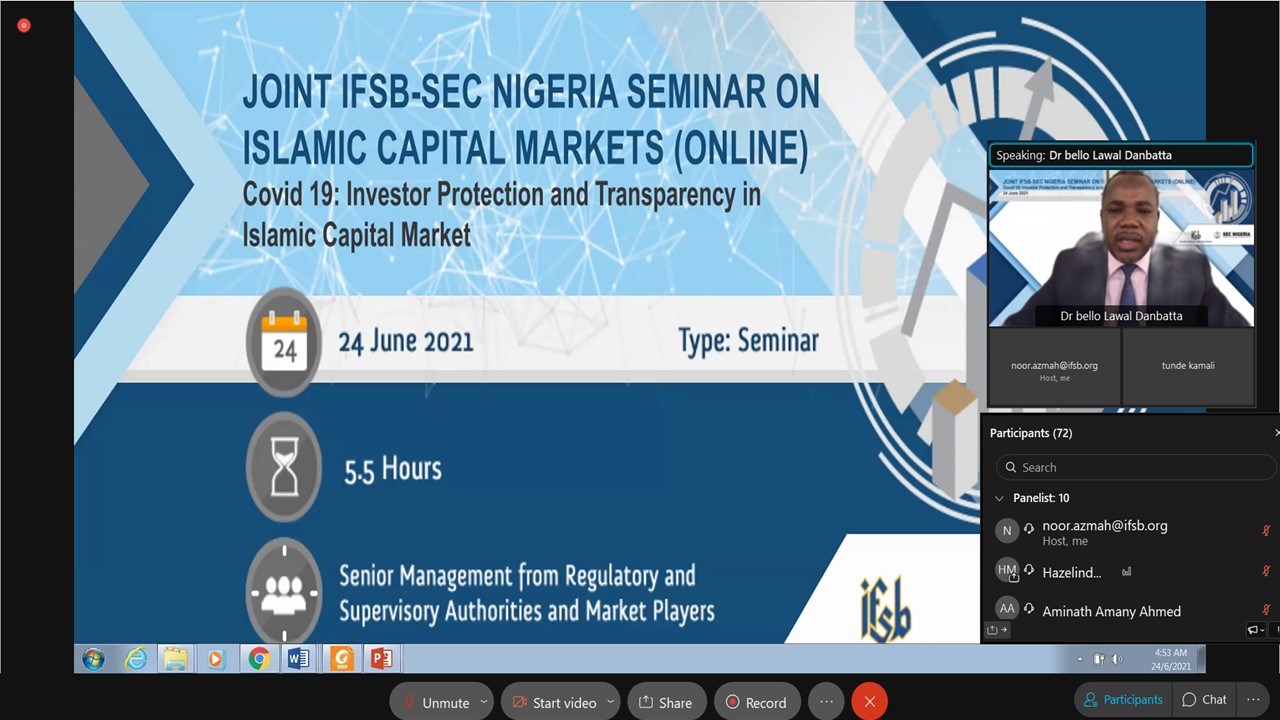
COVID 19: INVESTOR PROTECTION AND TRANSPARENCY IN ISLAMIC CAPITAL MARKET The pandemic has unexceptionally affected all economic and financial sectors globally, including the Islamic financial services sector. Given the ongoing uncertainty created by the pandemic and the potential risks it poses for economic growth and financial stability, protecting investors against possible market failures, as well as enhancing transparency and information available to investors are essential in regaining investor trust and confidence in the Islamic capital markets, which is in turn, crucial to prevent any deterioration of market conditions. Many market failures directly impact investors, including asymmetry of information, agency problems or detrimental conflicts of interest. They may affect the functioning of the market and contribute to the perception that capital markets are an unsafe environment. Thus, it is imperative for policy makers and regulators to address these issues through regulatory intervention, in order to rebuild investor confidence during volatile market conditions and to effectively address possible market failures that could impact the level of protection of investors. Better protected investors are also likely to make more informed investment decisions and be less prone to react irrationally to market events or follow “herd behavior” which are disruptive for financial markets and the economy as a whole. Thus, transparency and investor protection can be seen as factors that ultimately contribute to the stability of financial markets. The seminar therefore aims to increase awareness of the importance of investor protection and transparency in fostering investor confidence and ultimately the sustainability and stability of the Islamic capital markets and to provide a platform to discuss critical policy issues arising in the context of the current global financial environment. Objectives The seminars’ main objectives are to: Address Islamic finance-specific issues in relation to investor protection. Discuss best practices for investor protection in the ICM and the elements of a robust investor protection framework. Highlight best practices and guidelines on disclosure requirements for ICM products, specifically for ṣukūk and Islamic collective investment schemes (ICIS). Identify issues arising from the current global environment, and share policy actions taken by various regulators and policy makers to address emerging challenges and issues. Programme Outcome At the end of the seminar, participants will have a comprehensive understanding on investor protection and disclosure requirements to strengthen investor confidence and improve financial market performance. The seminar will be structured around guidance from IFSB standards, as well as experiences from the industry. Participants will be able to takeaway insights on the various policy approaches and best practices in different jurisdictions to address new and emerging issues related to investor protection and transparency in light of the new global realities. Programme Approach Interactive discussions on a wide array of issues on investor protection and transparency in the ICM Discussion on the best market practices and regulatory challenges Event Snapshots Programme - Event Session(s) Date Time Topics Day 1 24/06/2021 16:30 - 16:45 Welcoming Remarks (IFSB) Dr. Bello Lawal Danbatta, Secretary-General, Islamic Financial Services Board 16:45 - 17:00 Opening Remarks (SEC Nigeria) Mr. Lamido Yugaga, Director General, SEC Nigeria 17:00 - 17:45 Session 1: Overview of the Islamic Capital Markets in Nigeria Development and growth of the Islamic capital markets in Nigeria Islamic finance development, products and issuances in Nigeria Regulatory developments and challenges COVID-19 and impact on the market Presenter: Mr. Abdulkadir Abbas, Head of Department – Securities and Investment Services, SEC Nigeria 17:45 - 17:50 Short Break 17:50 - 18:30 Session 2: Strengthening Investor Protection in the Islamic Capital Markets Overview of regulatory issues and the key principles of investor protection; Overview of the global Islamic capital markets and trends The role of product governance, conduct of business requirements (including client assets, best execution, and conflicts of interest etc.), and good practices in relation to investor redress and investor education, and; Emerging investor protection issues in the Islamic capital markets in the context of the current global environment Presenter: Ms. Aminath Amany Ahmed, Member of the Secretariat, Islamic Financial Services Board 18:30 - 19:30 Afternoon Break 19:30 - 20:15 Session 3: Enhancing Transparency in the Islamic Capital Market (Sukuk) Principles of transparency and disclosure for Sukuk and regulatory best practices Overview of key regulatory considerations and specificities of Sukuk Role of transparency and disclosure in protecting Sukuk investors Addressing emerging issues and challenges for Sukuk through better informed investors Presenter: Peter Casey, Consultant, Islamic Financial Services Board 20:15 - 20:20 Short Break 20:20 - 21:05 Session 4: Enhancing Transparency in the Islamic Capital Market (ICIS) Overview of key regulatory considerations and specificities of ICIS Principles of transparency and disclosure for ICIS and regulatory best practices Role of transparency and disclosure in protecting ICIS investors Addressing emerging issues and challenges for ICIS through better informed investors Presenter: Peter Casey, Consultant, Islamic Financial Services Board 21:05 - 21:15 Short Break 21:15 - 22:00 Session 5: Panel: Safeguarding investors in a challenging global environment Implications of the COVID-19 pandemic for the Islamic capital markets Policy actions taken by regulators to mitigate the impact of the pandemic Key investor protection issues arising from the unprecedented economic and financial market conditions and addressing these issues; Promoting investors’ confidence in an uncertain environment through greater market transparency, assessment and information. Q&A on specific considerations and policy issues unique to the Islamic capital market and the way forward. Panelists: Peter Casey, IFSB Consultant (Lead Panelist) Mr. Abdulkadir Abbas, Head of Department – Securities and Investment Services, SEC Nigeria Mrs. Hajara Adeola, Managing Director, Lotus Capital Limited Mr. Hichem Bouqniss, Execuitve Director, International Islamic Liquidity Management Corporation
COVID 19: INVESTOR PROTECTION AND TRANSPARENCY IN ISLAMIC CAPITAL MARKET The pandemic has unexceptionally affected all economic and financial sectors globally, including the Islamic financial services sector. Given the ongoing uncertainty created by the pandemic and the potential risks it poses for economic growth and financial stability, protecting investors against possible market failures, as well as enhancing transparency and information available to investors are essential in regaining investor trust and confidence in the Islamic capital markets, which is in turn, crucial to prevent any deterioration of market conditions. Many market failures directly impact investors, including asymmetry of information, agency problems or detrimental conflicts of interest. They may affect the functioning of the market and contribute to the perception that capital markets are an unsafe environment. Thus, it is imperative for policy makers and regulators to address these issues through regulatory intervention, in order to rebuild investor confidence during volatile market conditions and to effectively address possible market failures that could impact the level of protection of investors. Better protected investors are also likely to make more informed investment decisions and be less prone to react irrationally to market events or follow “herd behavior” which are disruptive for financial markets and the economy as a whole. Thus, transparency and investor protection can be seen as factors that ultimately contribute to the stability of financial markets. The seminar therefore aims to increase awareness of the importance of investor protection and transparency in fostering investor confidence and ultimately the sustainability and stability of the Islamic capital markets and to provide a platform to discuss critical policy issues arising in the context of the current global financial environment. Objectives The seminars’ main objectives are to: Address Islamic finance-specific issues in relation to investor protection. Discuss best practices for investor protection in the ICM and the elements of a robust investor protection framework. Highlight best practices and guidelines on disclosure requirements for ICM products, specifically for ṣukūk and Islamic collective investment schemes (ICIS). Identify issues arising from the current global environment, and share policy actions taken by various regulators and policy makers to address emerging challenges and issues. Programme Outcome At the end of the seminar, participants will have a comprehensive understanding on investor protection and disclosure requirements to strengthen investor confidence and improve financial market performance. The seminar will be structured around guidance from IFSB standards, as well as experiences from the industry. Participants will be able to takeaway insights on the various policy approaches and best practices in different jurisdictions to address new and emerging issues related to investor protection and transparency in light of the new global realities. Programme Approach Interactive discussions on a wide array of issues on investor protection and transparency in the ICM Discussion on the best market practices and regulatory challenges Programme - Event Session(s) Date Time Topics Day 1 30/06/2021 13:30 - 13:45 Welcoming Remarks (IFSB) Dr. Bello Lawal Danbatta, Secretary-General, Islamic Financial Services Board 13:45 - 14:00 Opening Remarks (CMA Kenya) Mr. Wycliffe Shamiah, Chief Executive Officer, Capital Market Authority 14:00 - 15:00 Session 1: Introduction to the Islamic Capital Markets Development and growth of the Islamic capital markets in Nigeria Islamic finance development, products and issuances in Nigeria Regulatory developments and challenges COVID-19 and impact on the market Presenter: Mr. Saad Rahman, Deputy Chief Executive Officer, Salaam Investment Bank Kenya (SIBK) 15:00 - 15:15 Short Break 15:15 - 16:15 Session 2: Strengthening Investor Protection in the Islamic Capital Markets Overview of the global Islamic capital markets and trends Overview of regulatory issues and the key principles of investor protection; The role of product governance, conduct of business requirements (including client assets, best execution, and conflicts of interest etc.), and good practices in relation to investor redress and investor education, and; Emerging investor protection issues in the Islamic capital markets in the context of the current global environment Presenter: Ms. Aminath Amany Ahmed, Member of the Secretariat, Islamic Financial Services Board 16:15 - 16:30 Short Break 16:30 - 17:00 Session 3: Enhancing Transparency in the Islamic Capital Market (Sukuk) Overview of key regulatory considerations and specificities of Sukuk Principles of transparency and disclosure for Sukuk and regulatory best practices Role of transparency and disclosure in protecting Sukuk investors Addressing emerging issues and challenges for Sukuk through better informed investors Presenter: Peter Casey, Consultant, Islamic Financial Services Board 17:00 - 17:15 Short Break 17:15 - 18:00 Session 4: Panel: Safeguarding investors in a challenging global environment Implications of the COVID-19 pandemic for the Islamic capital markets Policy actions taken by regulators to mitigate the impact of the pandemic Key investor protection issues arising from the unprecedented economic and financial market conditions and addressing these issues; Promoting investors’ confidence in an uncertain environment through greater market transparency, assessment and information. Q&A on specific considerations and policy issues unique to the Islamic capital market and the way forward. Panelists: Peter Casey, IFSB Consultant (Lead Panelist) Mr. Luke Ombara, Policy and Market Development, CMA Kenya Mr. Saad Rahman, Deputy Chief Executive Officer, Salaam Investment Bank Kenya (SIBK)
Programme Overview The pandemic has unexceptionally affected all economic and financial sectors globally, including the Islamic financial services sector. Given the ongoing uncertainty created by the pandemic and the potential risks it poses for economic growth and financial stability, protecting investors against possible market failures, as well as enhancing transparency and information available to investors are essential in regaining investor trust and confidence in the Islamic capital markets, which is in turn, crucial to prevent any deterioration of market conditions. Many market failures directly impact investors, including asymmetry of information, agency problems or detrimental conflicts of interest. They may affect the functioning of the market and contribute to the perception that capital markets are an unsafe environment. Thus, it is imperative for policy makers and regulators to address these issues through regulatory intervention, in order to rebuild investor confidence during volatile market conditions and to effectively address possible market failures that could impact the level of protection of investors. Better protected investors are also likely to make more informed investment decisions and be less prone to react irrationally to market events or follow “herd behavior” which are disruptive for financial markets and the economy as a whole. Thus, transparency and investor protection can be seen as factors that ultimately contribute to the stability of financial markets. The seminars’ main objectives are to: Address Islamic finance-specific issues in relation to investor protection. Discuss best practices for investor protection in the ICM and the elements of a robust investor protection framework. Highlight best practices and guidelines on disclosure requirements for ICM products, specifically for ṣukūk and Islamic collective investment schemes (ICIS). Identify issues arising from the current global environment, and share policy actions taken by various regulators and policy makers to address emerging challenges and issues.The seminar therefore aims to increase awareness of the importance of investor protection and transparency in fostering investor confidence and ultimately the sustainability and stability of the Islamic capital markets and to provide a platform to discuss critical policy issues arising in the context of the current global financial environment Programme Outcome At the end of the seminar, participants will have a comprehensive understanding on investor protection and disclosure requirements to strengthen investor confidence and improve financial market performance. The seminar will be structured around guidance from IFSB standards, as well as experiences from the industry. Participants will be able to takeaway insights on the various policy approaches and best practices in different jurisdictions to address new and emerging issues related to investor protection and transparency in light of the new global realities. Programme Approach Interactive discussions on a wide array of issues on investor protection and transparency in the ICM. Discussion on the best market practices and regulatory challenges. Programme - Event Session(s) Date Time Topics Day 1 01/07/2021 12:00 - 12:50 Session 1: Strengthening Investor Protection in the Islamic Capital Markets Overview of the global Islamic capital markets and trends Overview of regulatory issues and the key principles of investor protection; The role of product governance, conduct of business requirements (including client assets, best execution, and conflicts of interest etc.), and good practices in relation to investor redress and investor education, and; Emerging investor protection issues in the Islamic capital markets in the context of the current global environment Presenter: Aminath Amany Ahmed, Member of the Secretariat, Islamic Financial Services Board (IFSB) 13:00 - 13:50 Session 2: Enhancing Transparency in the Sukuk Market Overview of key regulatory considerations and specificities of Sukuk Principles of transparency and disclosure for Sukuk practices Role of transparency and disclosure in protecting Sukuk Addressing emerging issues and challenges for Sukuk through better informed investors Presenter: Peter Casey, IFSB Consultant 14:00 - 14:50 Session 3: Enhancing Transparency in the Islamic Capital Market (ICIS) Overview of key regulatory considerations and specificities of ICIS Principles of transparency and disclosure for ICIS and regulatory best practices Role of transparency and disclosure in protecting ICIS investors Addressing emerging issues and challenges for ICIS through better informed investors Presenter: Peter Casey, IFSB Consultant 15:00 - 15:50 Q&A - Safeguarding investors in a challenging global environment Implications of the COVID-19 pandemic for the Islamic capital markets Policy actions taken by regulators to mitigate the impact of the pandemic Key investor protection issues arising from the unprecedented economic and financial market conditions and addressing these issues; Promoting investors’ confidence in an uncertain environment through greater market transparency, assessment and information. Q&A on specific considerations and policy issues unique to the Islamic capital market and the way forward. Panelists: Dr. Rifki Ismal, Assistant Secretary-General of the IFSB Peter Casey, IFSB Consultant Mr. Noraizat Shik Ahmad, General Manager, ICM Product Development, Securities Commission Malaysia Mr. Akber Khan Senior Director, Asset Management Group, Al Rayan Investment
Type: Seminar Target Audience: Senior Management from Regulatory and Supervisory Authorities and Market Players Duration: 4 hours Program Overview: The pandemic has unexceptionally affected all economic and financial sectors globally, including the Islamic financial services sector. Given the ongoing uncertainty created by the pandemic and the potential risks it poses for economic growth and financial stability, protecting investors against possible market failures, as well as enhancing transparency and information available to investors are essential in regaining investor trust and confidence in the Islamic capital markets, which is in turn, crucial to prevent any deterioration of market conditions. Many market failures directly impact investors, including asymmetry of information, agency problems or detrimental conflicts of interest. They may affect the functioning of the market and contribute to the perception that capital markets are an unsafe environment. Thus, it is imperative for policy makers and regulators to address these issues through regulatory intervention, in order to rebuild investor confidence during volatile market conditions and to effectively address possible market failures that could impact the level of protection of investors. Better protected investors are also likely to make more informed investment decisions and be less prone to react irrationally to market events or follow “herd behavior” which are disruptive for financial markets and the economy as a whole. Thus, transparency and investor protection can be seen as factors that ultimately contribute to the stability of financial markets. The seminar therefore aims to increase awareness of the importance of investor protection and transparency in fostering investor confidence and ultimately the sustainability and stability of the Islamic capital markets and to provide a platform to discuss critical policy issues arising in the context of the current global financial environment. Objectives The seminars’ main objectives are to: Address Islamic finance-specific issues in relation to investor protection. Discuss best practices for investor protection in the ICM and the elements of a robust investor protection framework. Highlight best practices and guidelines on disclosure requirements for ICM products, specifically for ṣukūk and Islamic collective investment schemes (ICIS). Identify issues arising from the current global environment, and share policy actions taken by various regulators and policy makers to address emerging challenges and issues. Programme Outcome At the end of the seminar, participants will have a comprehensive understanding on investor protection and disclosure requirements to strengthen investor confidence and improve financial market performance. The seminar will be structured around guidance from IFSB standards, as well as experiences from the industry. Participants will be able to takeaway insights on the various policy approaches and best practices in different jurisdictions to address new and emerging issues related to investor protection and transparency in light of the new global realities. Programme Approach Discussion on the best market practices and regulatory challenges Interactive discussions on a wide array of issues on investor protection and transparency in the ICM Event Snapshots:
COVID-19 has shifted the dynamics in the global Islamic financial services industry (IFSI). The necessary public health measures have created the need for businesses to change their course of action and overall outlook for the future. Beyond the immediate economic implications, COVID-19 is creating new opportunities by forcing the IFSI to adapt to rapidly evolving market conditions and speeding up the pace of emerging trends in socially responsible investing, sustainability, and digitalization to mitigate the impact of the outbreak. The Covid-19 outbreak has led to growth in the IFSI in some areas by accelerating trends such as socially responsible investing and a stronger focus on social sustainability. The impact of Covid-19 presented a window of opportunity for the Islamic capital market sector, particularly regarding the issuance of sovereign sukuk as a part of the government’s strategy to diversify its funding for financing fiscal deficit and to meet the fiscal requirements for combating Covid-19. In the business sectors, some IFSI have started to convert their ongoing business models into a more digital and virtual based businesses. Digital payment, monitoring, recording, reporting and even the Islamic financial institution and instrument themselves have become fully digital (virtual) which are now commonly called as digital banking, e-Sukuk, etc. in line with the issue of digital currency. Objectives: To discuss the recovery initiatives within the Global Islamic Financial Services Industry To discuss the limitation for IFSI and identify specific risk factors that might arise in relation to specificities of Islamic Finance To provide a better understanding on the challenges faced by the industry, particularly related to Cybersecurity Risk due to accelerated digitalisation and liquidity risk management. Register Now Event Snapshots:
Online IFSB Executive Programme Managing Digital Transformation Risks for Islamic Finance Institutions (IFIs) The Covid-19 pandemic has given a very important lessons to global financial services industry unexceptionally which the Islamic finance industry shall face post the pandemic. One of them is the necessity of accelerated digital business transformation which includes amongst others, changes in the business model, operations, technical mechanism, supervision and monitoring into the digital ones including larger and comprehensive risk assessment and mitigation. Physical business interactions, dealing, negotiation, financial transactions and execution may not be feasible nowadays and are changed into digital and virtual Islamic financial transactions. Currently, Islamic finance players have started to transform their products and services into digital ones for examples, e-deposit, e-sukuk, insurTech, e-payment, etc offered and operated via new business and digital based systems in the integrated financial market. Even, Islamic finance is now giving the greater attention on Islamic social finance, funds, products and instruments including the Environmental, Social and Governance (ESG). Sukuk awqf, digital zakah and awqf payment and distribution mechanisms are amongst the recent innovations in Islamic finance most of which IFSB Standards had provided clear guidance for both regulators and market players. To enhance participants understanding of operational risks and regulatory concerns associated with accelerated digital transformation for the Islamic banking, Islamic capital market and takaful institutions. To elevate key skills and competencies of participants on regulation, supervision and monitoring including comprehensive risk assessment and mitigation of digital transformation associated risks for IFIs. To equip participants with understanding and acceleration of Islamic social finance including new and innovative instruments, mechanism and programs. Interactive online discussion, providing direct engagement with subject matter experts and sharing of country and organisational experiences as well as using IFSB standards and technical notes as reference. Event Snapshots:
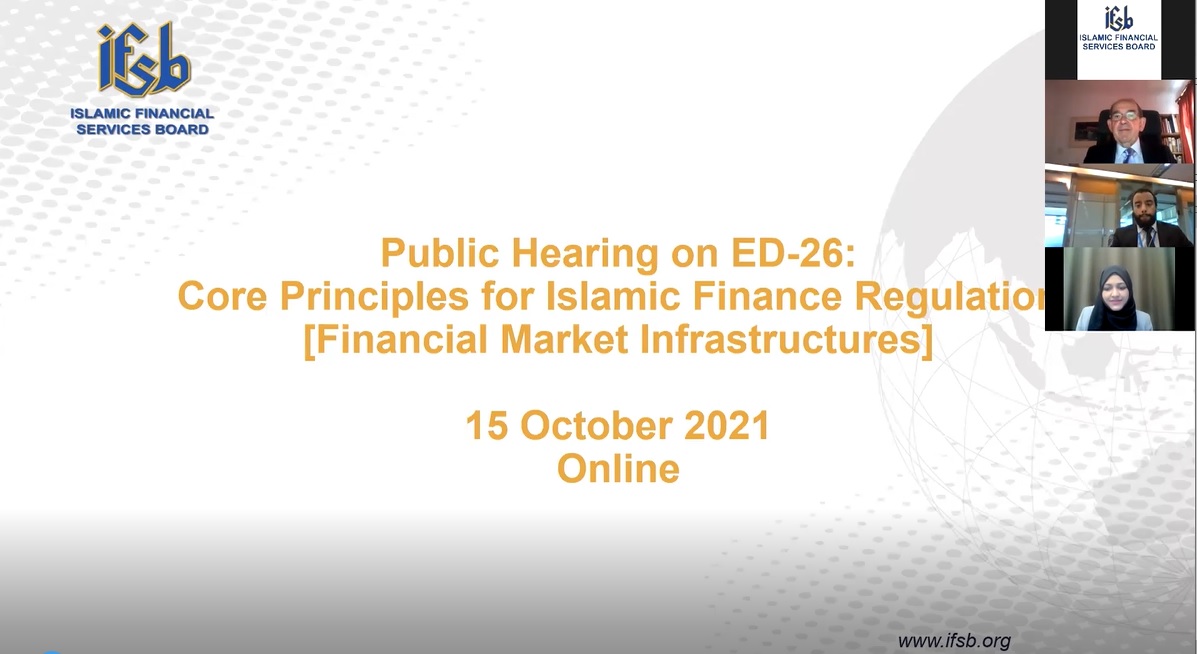
In its 3rd Extraordinary Technical Committee Meeting held on 9 September 2021, the Technical Committee of the Islamic Financial Services Board (IFSB) has approved the issuance of the of the following Exposure Draft (ED) : Core Principles for Islamic Finance Regulation (Financial Market Infrastructure) - ED-26 The Public Consultation will be for a period of 45 days, starting from 10 September 2021 until 25 October 2021. In conjunction to the above, the IFSB will be organising a Webinar for the Public Hearing on the ED-26 on 15 October 2021 at 4.00 PM (GMT +8.00, Malaysia time). Therefore, the IFSB would like to invite all members, stakeholders and interested parties to attend the above programme. Kindly register in advance for this webinar: https://zoom.us/webinar/register/WN_4XUyFdM6RsqgkP4xT9pNgw An email confirmation containing about joining the webinar will be sent after registration. We look forward to receiving your registration for Public Hearing session as well as feedback on ED-26. Event Snapshots:
Target Audience: IFSB members and non-members (RSA, market players, scholars and academics) Learning Objectives: The progress of digital transformation has accelerated in the midst of pandemic due to rising digitalization trend. Some central banks have conducted assessments and exercises on pros and cons of digital transformation in the regulators policies and initiatives particularly to maintain the financial system stability, economic transaction and increase the policy impacts to the real sectors including the Islamic finance. The focuses are mainly on: (i) can the central bank digital transformation perform a better economic policy transformation mechanism in the digital era? (ii) how can the economic policies (fiscal, monetary, finance, etc) be relied on and applied in the digital era? (iii) how is the financial stability framework and mechanism be maintained by adopting the central bank digital transformation? (iv) how is Sharia view and thought on some digital initiatives applied by the regulators? (v) and other central bank strategic policies and digital transformation issues can also be deliberated and shared in the event. Programme Outcome: The conference intends to elaborate and possibly gains consensus among policy makers, experts and sharia scholars on the issues and ideas of the digital transformation in the policy, market practices and Sharia initiative. Representatives from the central banks, international standard setting bodies, industry players and sharia scholars among resource persons in the event. The expected outcomes of the event are: (a) comprehensive understanding and thought on digital transformation from regulatory perspectives (central bank, financial regulators) mainly its financial and economic impacts, policy responses and financial (b) discussions from the market and industry players on some applications of digital transformation in financial transactions (crypto asset trading, bitcoin, etc) (c) knowing the Sharia views and thoughts on digital initiatives in the payment system, financial market transactions, banking system, etc mainly with the issues of Riba, gharar and maysir (speculation) in the digital transaction. Programme Approach: Following are the overall programme approaches: Explanation and elaboration of the issue, policy, market experiences and Sharia thoughts from the speakers (policy makers, market players and sharia scholars). Interactive discussion, debate, pros and cons opinions on the topic among speakers and limited (by invitation) audience. Conclusions or pre-requisite consensus on the issues being discussed. Suggestions on policy responses or market responses on the issues. Event Snapshots: Programme - Event Session(s): Day 1 00/00/0000 00:00 - 00:00 13:00 - 13:30 Registration and Opening by Master of Ceremony 13:30 - 14:00 Opening Remarks and Keynote Address Opening Remarks : Dr. Bello Danbatta, Secretary-General, IFSB Keynote Speech : Dr. Wimboh Santoso, Chairman, Otoritas Jasa Keuangan (OJK) 14:00 - 15:00 Session 1: Central Bank Digital Transformation: Policy Responses and Financial System Stability Central bank views, assessments and thought on central bank digital transformation particularly in relation to financial system stability, economic transaction and impacts on the real sectors Policy responses on central bank digital transformation: policy transformation, financial market and payment system policies. Central bank strategic policies in shaping financial industry and payment system in the digital era. Possible adoption with adjustments and modification with respect to the jurisdiction’s economic condition and policy measures. 15:00 - 16:00 Session 2: Financial Market and Industry Views, Assessments, and Shari’ah Thoughts on Digital Transformation in the Islamic Business and Economic Transactions Financial market dan banking responses on the current cases of the digital transactions such as digital payment, digital financial market transactions, digital financing, etc. Possible impacts of digital transformation in the Islamic economic and financial transactions: contract, trading, investor and customer protection, risk assessment, etc. Changing in the financial market and banking treatments and rules on digital transaction in the digital era. 16:00 - 16:15 Q & A Session
The 15th IFSB Summit aims to bring together financial industry leaders, experts, policymakers and other stakeholders to share knowledge, experience and expertise under the theme of “Islamic Finance and Digital Transformation: Balancing Innovation and Resilience”. The Summit will provide a forum to discuss policy priorities and strategies to foster renewed growth momentum in the Islamic financial services industry (IFSI), focusing particularly on digital transformation of Islamic financial services. The Summit will provide an opportunity to share ideas and deepen the understanding of emerging developments and advances in financial technology and digital finance across the various sectors of the IFSI, the different regulatory approaches and practices that have been applied by jurisdictions and their effectiveness, as well as the challenges and trade-offs, and the policy actions that are needed going forward to further promote innovation whilst ensuring resilience and financial stability. The sessions will also include discussions that renew the focus on harnessing the inherent values and principles of Islamic finance to provide value-based solutions to strengthen the link between innovation in Islamic finance and the real economy, while also supporting long term sustainable development and ESG objectives. Further, it will look at potential strategies to facilitate use of digital finance and financial technologies by Islamic financial institutions to target underserved populations and SMEs to foster more inclusive growth of Islamic finance. It will also provide opportunities to discuss relevant issues around structural changes in the Islamic finance industry as a result of technological developments, including management of cyber risk, issues around crypto-assets and the effective use of regulatory and supervisory technology. Across the various sessions during the two-day Summit, industry leaders will be able to discuss the most prominent and current issues in the industry and identify the key policy objectives going forward for standard setters as well as for national authorities. ENQUIRIES If you have any inquiries regarding registration or participation in the 15th IFSB Summit, please direct your queries to: Registration Sponsorship & Press Mr. Iswaran A/L Shamugam Tel.: +603 9195 1426 or +603 9195 1400 [email protected]. Noor Azmah Mohd Yusoff Tel: +603-9195 1434 [email protected] Ms. Natejah Ahmad Tel.: +603 9195 1426 or +603 9195 1400 [email protected]. Rosmawatie Abdul Halim Tel: +603-9195 1425 [email protected] TRAVELLING REQUIREMENTS Participants that physically attending the event shall make their own arrangement. However, should you require a letter from the IFSB to facilitate your visa application, please contact the IFSB Secretariat. Please see below travelling requirements requested by health authorities in Saudi Arabia with regard to Covid-19 precautions: Summit participants must obtain and show a proof of vaccination (vaccine certificates for COVID 19) with one of the flowing vaccines: 2 doses of Pfizer BioNTech 2 doses of Oxford AstraZeneca 2 doses of Moderna 1 dose of Johnson&Johnson’s Janssen Vaccine certificates are required to be certified by official health authorities from the country that provided the vaccination. The second dose of a two-dose vaccine or the first dose of a single dose vaccine should be taken at least (14) days before arrival to the Kingdom of Saudi Arabia. Summit participants must carry their vaccine certificates at all times during their stay in the kingdom (Or prove of health status through applications and accredited programs in the kingdom) Summit participants must provide a negative result of (PCR) test certificate not exceeding (72) hours before departure to the Kingdom of Saudi Arabia. Summit participants must provide a negative result of (PCR) test certificate not exceeding (72) hours before departure to the Kingdom of Saudi Arabia. For more information, please visit https://wwwnc.cdc.gov/travel/notices/covid-4/coronavirus-saudi-arabia Entry Status to KSA # Country Status 1. Egypt Banned 2. Lebanon Banned 3. Indonesia Banned 4. Turkey Banned 5. Pakistan Banned 6. Japan Quarantine required 7. Switzerland Quarantine required 8. UK Quarantine required 9. USA Quarantine required 10. Germany Quarantine required 11. All remaining countries No entry restrictions Before coming to Saudi Arabia, participants from allowed countries should not pass by the below countries for the 14 days before entering KSA: 1. Ireland 2. Germany 3. Indonesia 4. Italy 5. Pakistan 6. Brazil 7. Portugal 8. UK 9. USA 10. Turkey 11. Sweden 12. Switzerland 13. France 14. Lebanon 15. Egypt 16. India 17. Japan ACCOMMODATION INFORMATION Participants that physically attending the event shall make their own arrangement for accomodation. However, the Secretariat has secured preferential rates are the following hotels. You are required to make your reservations directly with the hotel. The reservation forms are available for download. https://www.ritzcarlton.com/en/hotels/saudi-arabia/jeddah ABOUT THE IFSB The Islamic Financial Services Board (IFSB) is an international standard-setting organisation that promotes and enhances the soundness and stability of the Islamic financial services industry by issuing global prudential standards and guiding principles for the industry, broadly defined to include banking, capital markets and insurance sectors. As at June 2021, the 187 members of the IFSB comprise 81 regulatory and supervisory authorities, 10 international inter-governmental organisations, and 96 market players (financial institutions, professional firms, industry associations and stock exchanges) operating in 57 jurisdictions. Towards this end, the IFSB works closely with relevant international, regional and national organisations, research/educational institutions and market players. For more information about the IFSB, please visit www.ifsb.org Latest IFSB Press Releases List of IFSB Members List of IFSB Publications List of IFSB upcoming events ABOUT CENTRAL BANK OF SAUDI ARABIA Saudi Central Bank, the central bank of the Kingdom of Saudi Arabia, was established in 1372H (1952). It has been entrusted with performing many functions pursuant to several laws and regulations. The most important functions are the following: To deal with the banking affairs of the Government; Minting and printing the national currency (the Saudi Riyal), strengthening the Saudi currency and stabilizing its external and internal value, in addition to strengthening the currency’s cover; Managing the Kingdom’s foreign exchange reserves; Managing the monetary policy for maintaining the stability of prices and exchange rate; Promoting the growth of the financial system and ensuring its soundness; Supervising
