
All Day

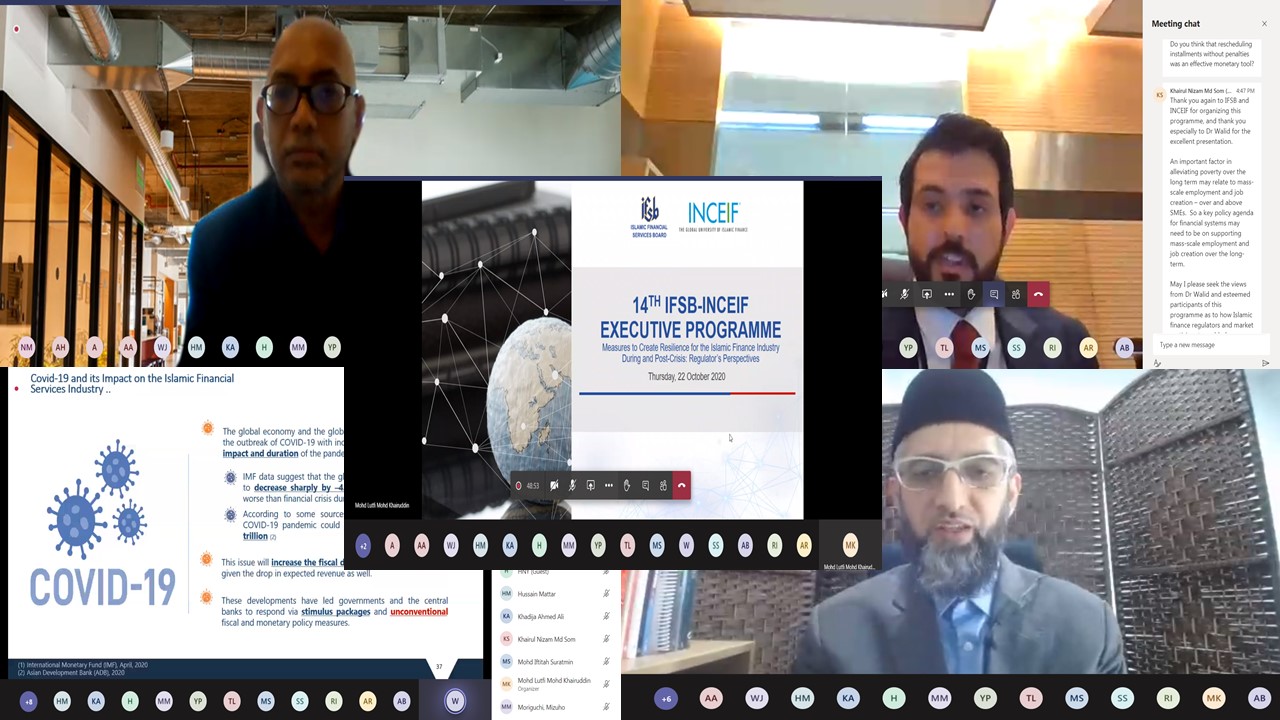
14th IFSB-INCEIF Executive Programme – Measures to Create Resilience for the Islamic Finance Industry During and Post-Crisis: Regulator’s Perspectives

Online

The COVID-19-induced global recession has been an unprecedented and unique crisis for the financial system, as a completely exogenous crisis originating from outside of the financial system. The unique crisis also presented the need for unique policy responses which makes it pertinent to examine how the financial system has responded during the crisis to manage it, and how it might move forward after the crisis to ensure economic and financial system recovery, stability, resilience and growth. It is also imperative to look at the gaps in the current regulatory system that become apparent during the crisis and which requires attention by standard-setters and regulators going forward. To identify the common gaps and shortcomings of the financial regulatory frameworks and approaches in preventing the financial industry from a crisis To discuss and elaborate policy measures and actions that need to be taken by regulators in order to maintain the financial system stability and create resilience of the financial industry during a crisis. To understand steps to be taken in sustaining both financial institutions and the economic development of the country post-crisis   Event Snapshots   Programme - Event Session(s) Date Time Topics Day 1 22/10/2020 14:30 - 14:40 Opening Remarks 14:40 - 15:25 Measures to Create Resilience for the Islamic Finance Industry During and Post-Crisis: Regulator’s PerspectivesAt the end of the session, participants will be able to identify best practices and steps that need to be taken in enhancing regulatory frameworksfor crisis management in protecting the financial industry amid crisis. What enhancements in the regulatory frameworks may be considered for financial regulation to effectively address crises? Are the current regulatory regimes for crisis management adequately equipped to handle severe stress scenarios and non-economic sources of crisis? How adaptable is the regulatory framework to new or unique crises? Are there appropriate coordination and integrative mechanisms among regulators for crisis management? 15:25 - 15:30 Break 15:30 - 16:15 Session 2: Regulators’ Responses to CrisisAt the end of the session, the participants would be able to understand what policy measures and actions need to be taken by regulators in order to ensure economic and financial system stability and create resilience of the financial industry during a crisis. What are the regulatory policy measures and programs/actions adopted by the regulatory authorities to address Covid-19 impacts on the Islamic financial  sector? How have regulators dealt with crisis preparedness to ensure the safety-net of Islamic financial institutions? What are the priorities for regulatory authorities in managing the soundness of Islamic financial institutions during the crisis? Are there material differences between the Islamic banking sector and its conventional counterparts in dealing with and recovering from the crisis? 16:15 - 16:20 Break 16:20 - 17:05 Session 3: Sustainability of Financial Institutions Post Crisis At the end of the session, the participants would be able to understand steps to be taken in sustaining both financial institutions and the economic development of the country post crisis. What are the strategies for ensuring continued sustainability of Islamic financial institutions post crisis? What is the way forward for Islamic financial institutions post crisis in the midst of Banking 4.0? What are the required actions for Islamic financial institutions to channel back their liquidity to the real sector as part of the economic recovery measures of the country? What are the roles of Islamic social finance to sustain economic recovery in line with the Sustainable Development Goals (SDGs)?   Downloadable Document(s) Event Session(s) - PDF Format
Ongoing

IFSB-FIS Workshop Series (Sudan)

The Corinthia Hotel Khartoum, Sudan Khartoum

This 4-day workshop is tailored for the regulatory and supervisory authorities and the market players for the banking sector within Sudan. The major focus of the workshop will be on the most recent Guiding Principles which address the new global regulatory requirements for the supervisory review process and for liquidity management. The workshop will discuss the following IFSB Standards: IFSB-16: Revised Guidance on Key Elements In The Supervisory Review Process of IIFS GN-6: Guidance Note on Quantitative Measures for Liquidity Risk Management in IIFS Overall, this Workshop aims to: Enhance the participants’ understanding of the respective Standards and Guiding Principles thereby facilitating the implementation of these standards in their respective jurisdictions; Assist the participants in the practical application of issues addressed in the particular standards through case studies, hands-on exercises and other interactive tools; and Promote the sharing of experiences among the participants on the implementation of respective IFSB Standards and Guiding Principles.  This Workshop is hosted by Central Bank of Sudan and participation in this Workshop is by INVITATION only. For queries, please contact the IFSB Secretariat, Mr. Hamizi Hamzah at [email protected]. Programme - Event Session(s) Date Time Topics Day 1 11/01/2016 09:00 - 09:30 Registration 09:30 - 09:45 Opening Session by the IFSB and the CBOS Representatives 09:45 - 11:00 Session 1: IFSB-16: Revised Guidance on Key Elements In The Supervisory Review Process (SRP) Introduction to IFSB-16 Necessary Preconditions for Effective Supervision Additional Considerations in the Issuance of an IIFS License Supervisory Approaches in the Supervision of IIFS 11:00 - 11:30 Group Photo and Coffee Break 11:30 - 13:00 Session 2: IFSB-16: Revised Guidance on Key Elements In The SRP - Continued Regulatory Capital Requirements Guidance on the Slotting Method Treatment of IAH and Displaced Commercial Risk Advanced Approaches and Supervisory Discretion 13:00 - 14:00 Lunch and Prayer 14:00 - 16:00 Session 3: IFSB-16: Revised Guidance on Key Elements In The SRP - Continued Internal Capital Adequacy Assessment Process (ICAAP) ICAAP Framework for IIFS Supervisory Review Process in ICAAP Case Study 16:00 - 16:30 Coffee Break Day 2 12/01/2016 09:00 - 09:30 Registration 09:30 - 11:00 Session 4: IFSB-16: Revised Guidance on Key Elements In The SRP - Continued Corporate Governance Sharī`ah Governance Risk Management Processes Enterprise-wide Risk Management Framework 11:00 - 11:30 Coffee Break 11:30 - 13:00 Session 5: IFSB 16: Revised Guidance on Key Elements In The SRP - Continued Related Party Transactions Secrutisation Risk and Related Off-balance Sheet Exposures Special Purpose Entities (SPEs) and Key Considerations in the Supervisory Review Process Case Study 13:00 - 14:00 Lunch and Prayer 14:00 - 16:00 Session 6: IFSB 16: Revised Guidance on Key Elements In The SRP - Continued Transparency and Market Discipline Consolidated and Home-host Supervision Supervisory College and IIFS Specific Issues Case Study 16:00 - 16:30 Coffee Break Day 3 13/01/2016 09:00 - 09:30 Registration 09:30 - 11:00 Session 7: IFSB 16: Revised Guidance on Key Elements In The SRP - Continued Supervisory Review for Credit Concentration Risk Concentration Limits for Real Estate Investment Islamic Windows Operations Case Study 11:00 - 11:30 Coffee Break 11:30 - 13:00 Session 8: IFSB-16: Revised Guidance on Key Elements In The SRP - Continued Liquidity Risk Management and Supervision Sound Stress Testing Practices Sharī`ah-compliant Hedging Techniques Supervisory Transparency and Accountability 13:00 - 14:00 Lunch and Prayer 14:00 - 16:00 Session 9: GN-6: Guidance Note on Quantitative Measures for Liquidity Risk Management Application of the Liquidity Coverage Ratio (LCR) in IIFS Definition and Categorisation of High Quality Liquid Assets (HQLA) Operational Considerations for HQLA Infrastructure Issues in the Availability of Sharī`ah-compliant HQLA 16:00 - 16:30 Coffee Break Day 4 14/01/2016 09:00 - 09:30 Registration 09:30 - 11:00 Session 10: GN-6: Guidance Note on Quantitative Measures for Liquidity Risk Management - Continued Components of Total Net Cash Outflows Categories of Cash Outflow Cash Inflows Case Study 11:30 - 11:30 Coffee Break 11:30 - 13:00 Session 11: GN-6: Guidance Note on Quantitative Measures for Liquidity Risk Management - Continued Net Stable Funding Ratio (NSFR) Application of the NSFR in IIFS The Internal Liquidity Adequacy Assessment and Supervisory Liquidity Review Processes Application of LCR and NSFR 13:00 - 14:00 Lunch and Prayer 14:00 - 16:00 Session 12: GN-6: Guidance Note on Quantitative Measures for Liquidity Risk Management - Continued Principles for Applying Alternative Liquidity Approaches Disclosure Requirements for LCR and NSFR Evaluation of the Market Liquidity of Assets Case Study 16:00 - 16:15 Closing & Certificate Giving Ceremony 16:15 - 16:45 Coffee Break Downloadable Document(s) 1.) Event Session(s) - PDF Format

IFSB-FIS Workshop Series (Tajikistan)

Dushnabe Dushnabe, Dushnabe

This 4-day workshop is tailored for the National Bank of Tajikistan. It will discuss the introduction to Islamic finance and the following IFSB Standards: IFSB-2: Capital Adequacy Standard for Institutions offering only Islamic Financial Services (IIFS) IFSB-16: Revised Guidance on Key Elements in the Supervisory Review Process of IIFS GN-4: Guidance Note in Connection with the IFSB Capital Adequacy Standard: The Determination of Alpha in the Capital Adequacy Ratio (CAR) for IIFS Overall, this Workshop aims to: Enhance the participants’ understanding of the respective Standards and Guiding Principles thereby facilitating the implementation of these standards in their respective jurisdictions; Assist the participants in the practical application of issues addressed in the particular standards through case studies, hands-on exercises and other interactive tools; and Promote the sharing of experiences among the participants on the implementation of respective IFSB Standards and Guiding Principles. This Workshop is hosted by the National Bank of Tajikistan and supported by the Islamic Development Bank. Participation in this Workshop is by INVITATION only. For queries, please contact the IFSB Secretariat, Mr. Hamizi Hamzah at [email protected]. Programme - Event Session(s) Date Time Topics Day 1 28/03/2017 08:30 - 09:00 Registration 09:00 - 09:30 Opening Remarks by the NBT and IFSB Representatives Group Photo 09:30 - 11:00 Session 1 - Introduction to Islamic Finance Concept of Islamic Finance Contracts in Islamic Finance Structures of Islamic Banking Products Prudential Issues in IIFS 11:00 - 11:30 Coffee Break 11:30 - 13:00 Session 2 - IFSB-2: Capital Adequacy Standard for IIFS Need for Capital Regulation Pillar 1: Capital Adequacy Ratio (CAR): Understanding the Components of CAR CAR Formulas - Standard and Supervisory Discretion Treatment of PSIA - Supervisory Discretion Formula 13:00 - 14:00 Lunch and Prayer 14:00 - 16:00 Session 3 - IFSB-2: Capital Adequacy Standard for IIFS (Cont’d) Credit Risk Weights for Various Counterparties Off-balance Sheet Exposures Exposures in Investments Made under Profit-Sharing Modes Credit Risk Mitigation Day 2 29/03/2017 09:30 - 11:00 Session 4 - IFSB-2: Capital Adequacy Standard for IIFS (Cont’d) Measurement of Capital Adequacy Requirements for Market Risk Measurement of Market Risk Market Risk Weight Conversion Factor Case Study 11:00 - 11:30 Coffee Break 11:30 - 12:00 Session 5 - IFSB-2: Capital Adequacy Standard for IIFS (Cont’d) Overview of Operational Risk Understanding Operational Risk in Islamic Finance Measuring Operational Risks Group Exercise 13:00 - 14:00 Lunch and Prayer 14:00 - 16:00 Session 6 - GN-4: Guidance Note in Connection with the IFSB Capital Adequacy Standard: The Determination of Alpha in the Capital Adequacy Ratio for IIFS Background of the Guidance Note Understanding Management of Profit-Sharing Investment Account (PSIA) Understanding the Concept of Alpha and Displaced Commercial Risk (DCR) Measurement of Risk Sharing in PSIA Day 3 30/03/2017 09:30 - 11:00 Session 7 - GN-4: Guidance Note in Connection with the IFSB Capital Adequacy Standard: The Determination of Alpha in the Capital Adequacy Ratio for IIFS (Cont’d) The Determination of Alpha and DCR Issues on Prudential Regulations and Requirements Role of Supervisory Authority in Determination of Alpha and DCR Case Study 11:00 - 11:30 Coffee Break 11:30 - 13:00 Session 8 - IFSB-16: Revised Guidance on Key Elements In The Supervisory Review Process Necessary Preconditions for Effective Supervision Supervisory Approaches in the Supervision of IIFS Regulatory Capital Requirements Advanced Approaches and Supervisory Discretion 13:00 - 14:00 Lunch and Prayer 14:00 - 16:00 Session 9 -IFSB-16: Revised Guidance on Key Elements In The Supervisory Review Process (Cont’d) Internal Capital Adequacy Assessment Process (ICAAP) Corporate and Sharī'ah Governance Related Party Transactions Case Study Day 4 31/03/2017 08:30 - 10:00 Session 10 - IFSB-16: Revised Guidance on Key Elements In The Supervisory Review Process (Cont’d) Transparency and Market Discipline Consolidated and Cross-sector Supervision Risk Concentrations in IIFS Case Study 10:00 - 10:15 Coffee Break 10:15 - 11:45 Session 11 - IFSB-16: Revised Guidance on Key Elements In The Supervisory Review Process (Cont’d) Islamic “Windows” Operations Liquidity Risk Management and Supervision Sound Stress Testing Practices Supervisory Transparency and Accountability 11:45 - 12:15 Closing & Certificate Giving Ceremony